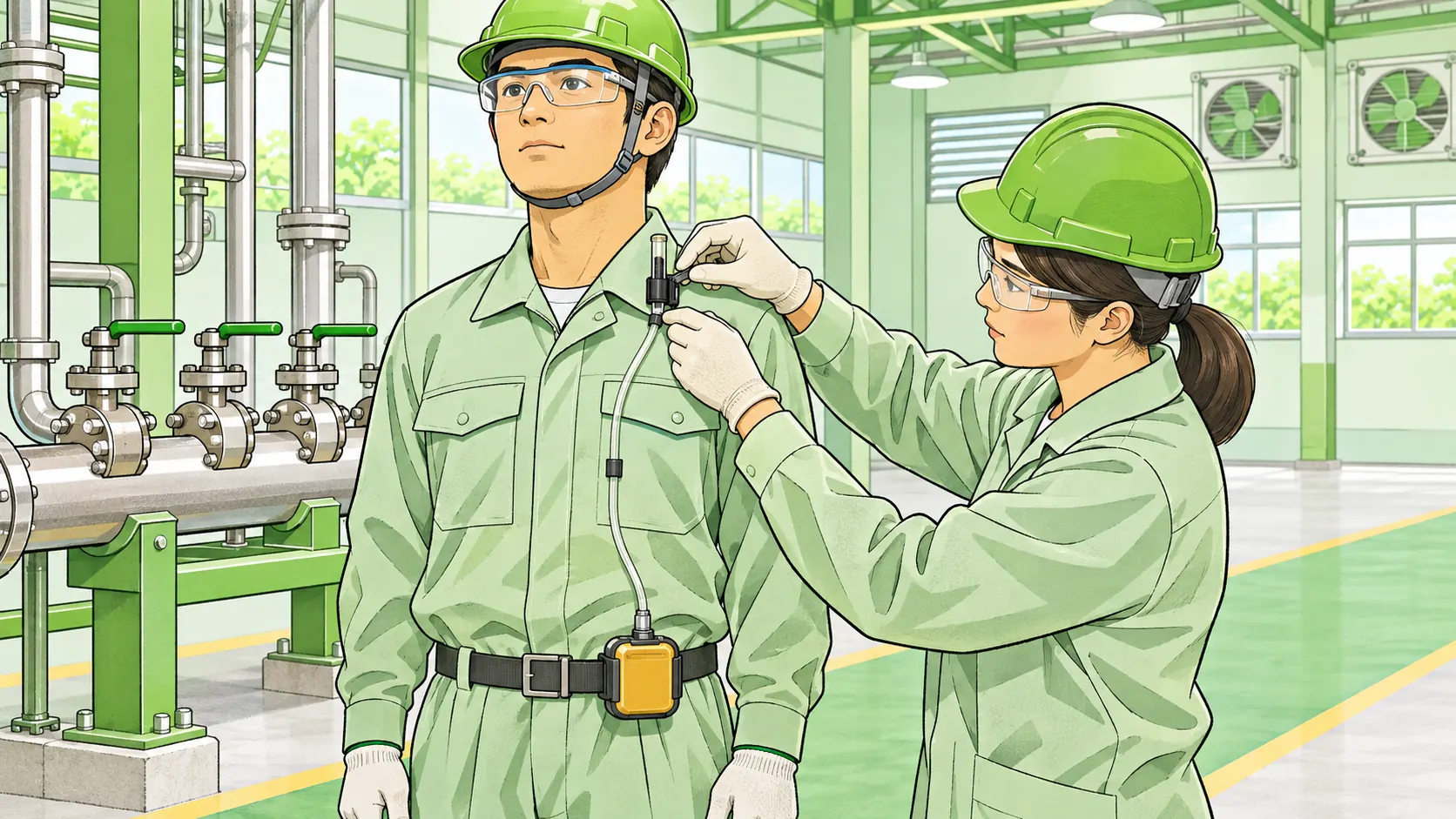
To measure a worker’s exposure to benzene, collect air near the nose and mouth while the worker does the job. Use a personal pump with a charcoal tube or a passive badge validated for benzene, and have the sample analysed for benzene specifically. Cover the full shift to estimate average exposure. Take a separate 15-minute sample during an operation likely to produce high exposure. A shift average can hide a short release, and a reading beside a valve tells you little about the dose in a worker’s breathing zone.
This approach addresses operations covered by the U.S. federal Occupational Safety and Health Administration (OSHA) benzene standard, 29 CFR 1910.1028. Check paragraph (a) before applying its limits or monitoring schedule. Oil and gas drilling, production and servicing are excluded, for example, and gasoline distribution has specific exceptions. The presence of benzene on a safety data sheet identifies a substance to investigate. The sheet alone cannot establish the airborne concentration for a particular job.
Plan for the shift and for the highest-exposure task
Before ordering sampling media, identify who handles the material, which operations open the process, where people stand and how long the work lasts. Include routine transfers and infrequent tasks such as opening process equipment. Ask the operator when the seal is broken and when it is restored. Those times help the sampler capture the part of the job most likely to affect the result.
| Question | Sample to collect | What to compare |
|---|---|---|
| What is the average exposure? | One or more personal samples representing the full shift for each job classification in each work area. | Eight-hour time-weighted average (TWA). The action level is 0.5 parts per million (ppm). The permissible exposure limit is 1 ppm. |
| Can a short task exceed the limit? | A separate 15-minute breathing-zone sample timed to an operation where high exposure is reasonably suspected. | The 15-minute short-term exposure limit (STEL) is 5 ppm. Compare the concentration over that interval, independently of the shift result. |
For initial monitoring, plan coverage across the shifts that workers actually perform. For subsequent monitoring, the employer can concentrate on the highest-exposure shift for an operation when it can document that this shift consistently has the higher exposure. Keep the reason for treating one person’s sample as representative of another’s. A shared job title can conceal differences in time spent opening lines or working beside a transfer point. See paragraphs (c) and (e)(1)–(2).
Choose a sampler that can answer the question
Start with the concentration and time period the laboratory needs to measure. A badge suitable for a full shift may collect too little benzene during a short task. Ask the laboratory for the reporting limit at the planned sampling duration, the media it accepts and the conditions that could invalidate the result.
- Personal pump and charcoal tube. The pump draws a measured volume of air through the tube. The laboratory measures the benzene collected and uses the sampled volume to calculate the air concentration. OSHA Method 1005 recommends 50 millilitres per minute for its charcoal tube. At that flow, its 15-minute sample collects 0.75 litres. Its recommended TWA collection is 240 minutes per tube, so plan consecutive tubes to cover an eight-hour shift. Use the rate and media specified for the method actually selected.
- Passive diffusion badge. Vapour reaches the sorbent without a pump. The calculation depends on the validated uptake rate and the time the badge was exposed. Method 1005 evaluates specific badge models for both 240-minute and 15-minute samples. Check the exact model, duration and reporting limit before substituting another badge.
- Direct-reading equipment. A portable instrument can help locate releases and choose the 15-minute sampling window. A general vapour detector may respond to several solvents. Its reading cannot be assigned to benzene in a mixture without evidence of selectivity. To use a direct-reading method for a compliance decision, establish that it measures benzene at the required accuracy under the conditions of use and represents the worker’s breathing zone for the relevant period.
The collection conditions and laboratory analysis are set out in OSHA Method 1005, version 2.1. OSHA discusses alternative measurement methods in Appendix D. A fixed area monitor can help trace a source or evaluate the area after a release. Personal sampling follows the worker as distance, position and ventilation change.
Collect a sample the laboratory can interpret
Agree on the sampling plan with the laboratory before the shift. Have enough media for the whole period, the separate short-term samples and the required field blanks. A field blank travels with the samples and is handled as the method directs, without drawing workplace air through it. It helps the laboratory identify contamination introduced during handling or transport.
Warning. A sampling badge records exposure for later analysis. It gives the wearer no immediate alarm. If a spill or process failure creates an emergency, follow the site’s emergency procedures before attempting routine sampling.
- Prepare and identify the equipment. Record the sampler identifier and worker, job, location and shift. For pumped sampling, verify and record the flow using representative sampling media and a suitable calibrator. For a badge, keep it sealed until the sampling interval begins.
- Place the inlet in the breathing zone. Clip the tube holder or badge near the worker’s collar with the opening unobstructed. Follow the method’s orientation instructions. Route tubing so it cannot kink or interfere with the work. Record the actual start time.
- Follow the task. Note transfers, openings, breaks, interruptions, control changes and the start and end of likely peak exposure. Replace media at the method’s interval. Time the STEL sample separately, even when a shift sampler is running.
- Close and document each sample. Record the stop time, verify the final pump flow where applicable, seal the media and submit the blanks. Tell the laboratory about interruptions, a stopped pump, possible overloading or missing time. Follow its storage and shipping instructions.
Check the laboratory report against the field notes before interpreting it. For consecutive samples, weight each concentration by the time it represents. A gap in coverage is an unknown exposure period. Identify it and decide whether the remaining data can still represent the shift. For a result below the reporting limit, check whether that limit is low enough to resolve the decision. “Below reporting limit” does not establish zero exposure.
Use the result to set controls and the next measurement
Read the shift and task results side by side. A low eight-hour average can accompany a 15-minute exceedance during equipment opening. Investigate the specific operation, review feasible engineering and work-practice controls, and check their effect during comparable work. This is where an occupational hygiene exposure assessment connects the laboratory number to a change at the source.
For covered employees, paragraphs (e)(3)–(5) set the federal monitoring schedule:
- Initial TWA below 0.5 ppm. The employer may discontinue routine TWA monitoring for that employee, subject to the additional-monitoring requirements.
- TWA from 0.5 through 1 ppm. Repeat at least annually. Above 1 ppm, repeat at least every six months. Moving from six-monthly to annual monitoring requires two consecutive results at least seven days apart in the annual range.
- Results fall below the action level during periodic monitoring. Two consecutive measurements below 0.5 ppm, at least seven days apart, are required before discontinuing periodic monitoring on that basis.
- Short exposures or changed conditions. Repeat STEL measurements as necessary. Reassess when changes to production, people, processes, controls or practices may create new or additional exposure. After a spill or breakdown that may expose workers, monitor after cleanup or repair to verify a return to pre-incident levels.
Within 15 working days of receiving the results, notify affected employees individually in writing or post them where employees can access them. When a permissible limit is exceeded, the written notice must identify the corrective action or refer workers to an accessible document describing it. Retain the sampling record with the task details so the next measurement tests whether the change worked. See paragraphs (e)(7), (f) and (k).