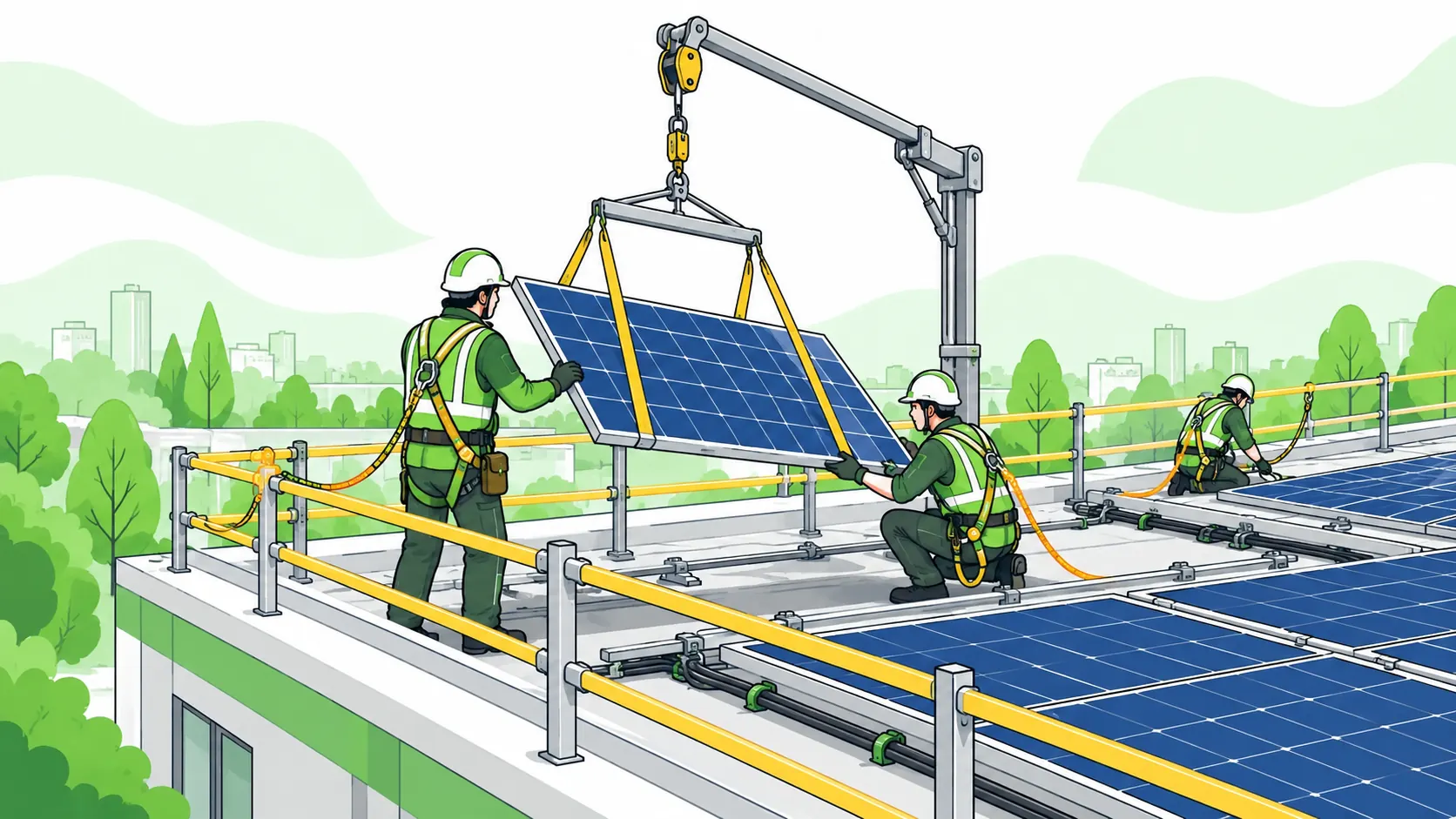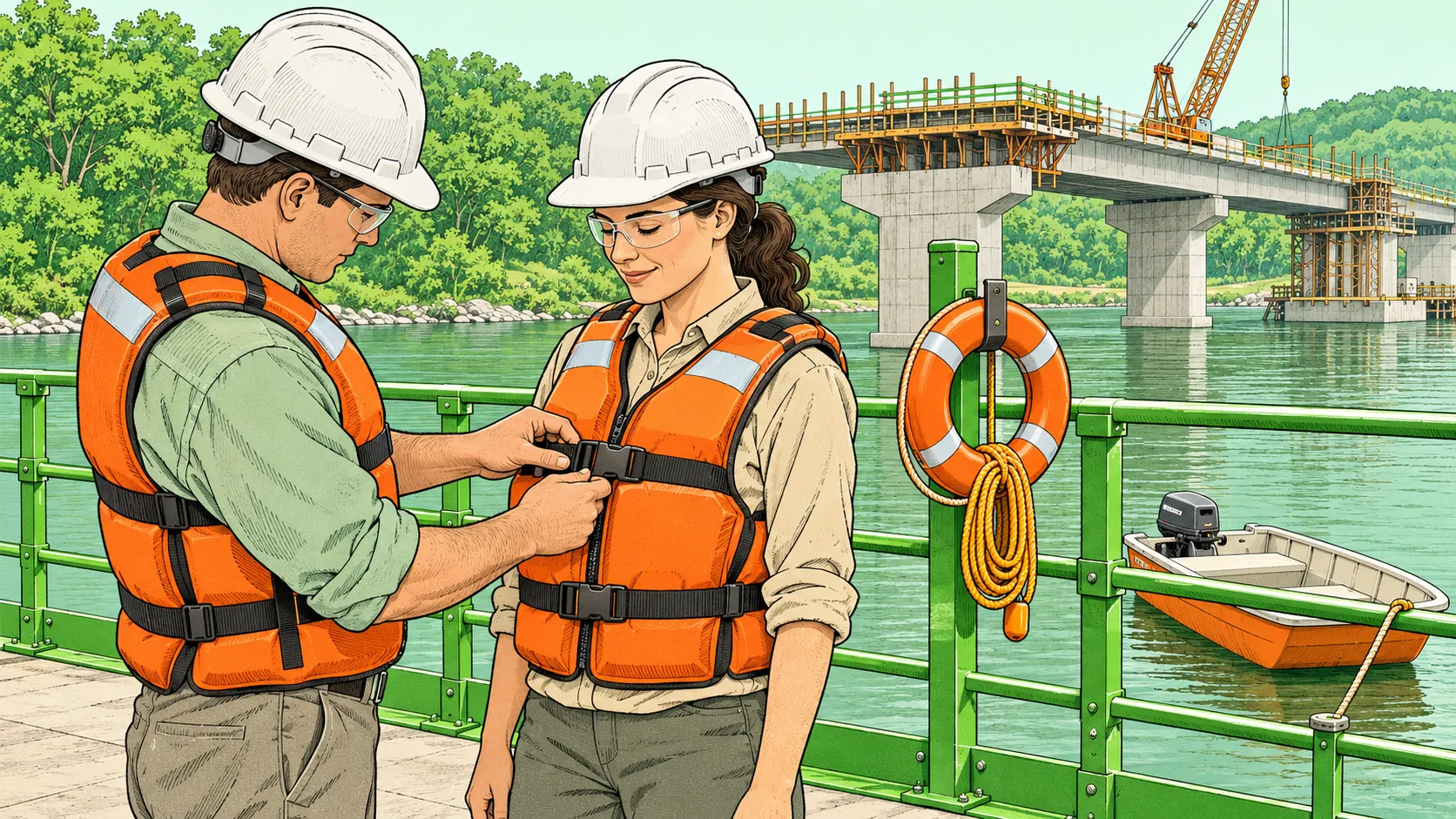
Construction workers need a U.S. Coast Guard-approved life jacket or buoyant work vest whenever they work over or near water and could drown. The employer must provide it, and workers should put it on before entering the exposed area. The decision can change during a single task: a guardrail may protect the crew on the bridge deck while leaving the person who opens the rail for a delivery exposed.
The federal Occupational Safety and Health Administration (OSHA) sets the construction requirement in 29 CFR 1926.106. This article covers U.S. construction work, including bridge and pier construction. Ship repair, shipbuilding and shipbreaking have separate rules. Check the applicable state-plan requirements for the jobsite.
Decide where the drowning hazard begins
Walk the crew’s route from access point to work area. Look at the bank, openings, changes of level and transfers between surfaces. Section 1926.106(a) gives no universal distance from the edge and no minimum water depth. Consider where a person could land, whether the fall could incapacitate them, and whether the depth or current could prevent them from regaining their footing. OSHA addresses these factors in its interpretation on shallow water.
Warning. Water shallow enough to stand in can still drown someone who is injured or unconscious. Assess the fall and the water conditions before releasing the area for work.
| Condition at the workface | Decision before access |
|---|---|
| Open edge with a fall path into water | Provide an approved wearable device and have exposed workers wear it. Assess any fall-protection duty separately. |
| Continuous protection prevents water entry | Under OSHA’s interpretation, a vest is generally unnecessary under paragraph (a) while that protection eliminates the drowning hazard. Verify the access route as well as the work position. |
| A rail must open or a connection must change | Plan the transition. Where continuous protection cannot be maintained and the drowning hazard returns, have workers wear the vest before the gap opens, however briefly. |
| Safety nets below the work | Check whether falling materials could damage the net. OSHA says nets usually leave a drowning hazard on marine construction work. Assess the installers’ exposure before the net is in service. |
OSHA explains the limits of the continuous-protection exception in its interpretation for piers, trestles and bridges. A harness on a worker’s back establishes little by itself. Check the connection and the available clearance throughout the movement. If a worker can reach the water during a fall, the system has not eliminated that exposure.
Check fall protection and flotation separately
For an unprotected side or edge covered by 29 CFR 1926.501(b)(1), six feet or more above a lower level triggers fall protection. Water counts as a lower level. The six-foot figure measures the drop from the working surface. It sets neither a safe depth of water nor a minimum height for wearing a vest. A worker closer to the water may still need flotation.
Where rails provide protection, check the OSHA guardrail requirements and inspect the actual perimeter for gaps. A supervisor should be able to point out where protection starts, how materials pass through and who restores an opening before other workers approach. Keep the rescue arrangements available even when effective rails remove the need for life jackets on the protected deck. OSHA specifically distinguishes the two duties in its bridge construction interpretation.
Select, fit and inspect the vest
A personal flotation device (PFD) for the exposed worker must be wearable and Coast Guard-approved. Section 1926.106(a) does not prescribe one approval classification for every construction task. Separate Coast Guard rules may require a particular type aboard a vessel. OSHA addresses this distinction in its interpretation on PFD selection for construction.
- Read the approval and sizing label. Match the device to its intended use and the wearer’s size. Check the weight and chest-size ranges where specified. The Coast Guard’s fitting advice explains what to look for on the label.
- Inspect before use. Look for damage that could reduce strength or buoyancy. Examine the flotation material, fabric, seams, straps and fasteners. For a device with an inflation mechanism, follow the manufacturer’s readiness checks for that model.
- Fit it before exposure. Fasten and adjust it over the clothing used for the job. Check that other protective equipment allows the vest to operate and that the worker can reach and use the required connections. Resolve any conflict before starting.
- Inspect again after use. Paragraph (b) requires checks both before and after each use. Take a defective unit out of service and provide a serviceable replacement before the next exposure.
Keep rescue equipment within reach of the crew
A vest helps a person stay afloat. Getting them out of the water requires someone who can reach them. Under paragraphs (c) and (d) of the construction standard, ring buoys must be readily available, each with at least 90 feet of line, and the distance between buoys must be no more than 200 feet. At least one lifesaving skiff must be immediately available where employees work over or adjacent to water.
Check rescue readiness from the active work location before the crew starts:
- Locate the nearest ring buoy. Check that a worker can reach it, retrieve the line and throw it without first moving stored materials.
- Identify the designated skiff operator and check how the crew will communicate the precise location of a fall. Verify the operator can reach the boat and get underway promptly.
- Check the skiff’s motor and oars, its route to the crew and whether current, distance or separate work fronts require additional coverage. OSHA explains these practical tests in its interpretation of immediate skiff availability.
OSHA recognises a narrow shallow-water exception where rescuers could readily run in and a skiff would ground. A depth reading alone cannot establish that this exception applies. Reassess the rescue route and the vest decision together whenever the crew moves, the water level changes or a new construction phase alters edge protection.