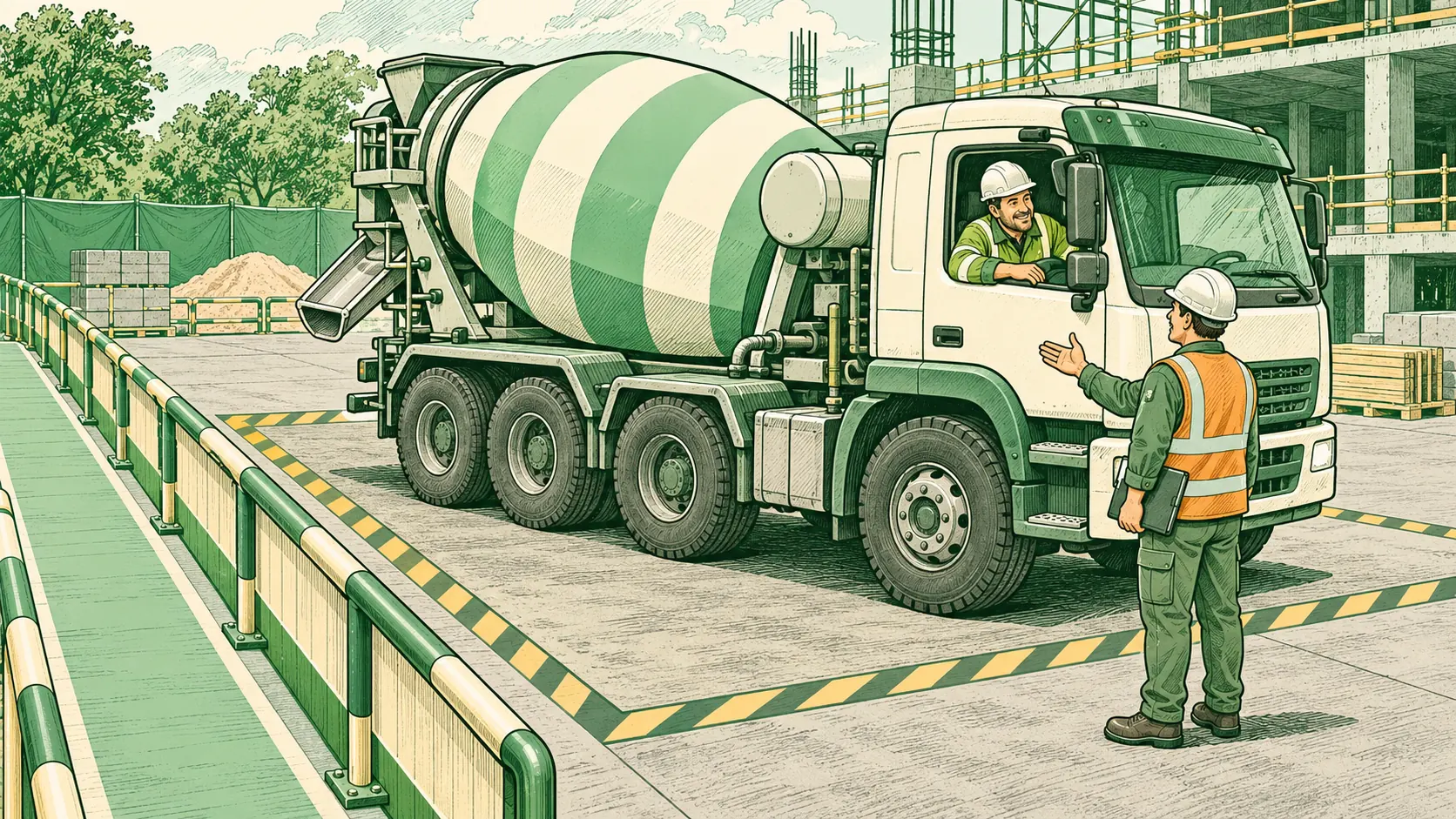
Before a ready-mix truck arrives, agree on a route, a firm discharge position and the person directing the delivery. Keep pedestrians away from the truck’s path. If conditions change or the driver loses sight of the designated spotter during a guided reverse, stop the movement. Resume only when the route, people and signals are under control again.
The handovers matter as much as the driving. The supplier knows the vehicle, the site team controls access and the pump operator controls the pump. Each needs a clear way to hold the delivery when the others cannot see a problem.
Before booking, check the route for a loaded mixer
The site supervisor and supplier should agree on the delivery vehicle, expected arrival time, entrance, waiting area and discharge method. Check the full route from the public road to the pour and back out. A gate wide enough for the cab says little about turning space, overhead clearance or whether a loaded mixer can use the ground beyond it.
- Ground and edges. Identify soft fill, buried services, recently backfilled trenches, covers and excavation edges. Get the site’s competent person to assess doubtful ground and confirm the available route. A previous vehicle crossing is poor evidence of capacity for the loaded mixer.
- People and traffic. Plan physical separation from pedestrian routes, trade access and members of the public. Choose a drive-through arrangement where possible. Identify any unavoidable reverse and how the reversing area will be kept clear.
- Headroom and services. Confirm the route and discharge point are compatible with the vehicle and nearby plant. Where overhead power lines could be involved, get the relevant site controls and clearances established before assigning the position.
- Timing and waiting. Space trucks to the site’s receiving capacity. Give dispatch a safe place to hold the next load and a named contact who can delay it. Queuing across a crossing can undermine an otherwise sound plan.
The UK Health and Safety Executive’s guidance on construction traffic management explains why separating people from vehicles and eliminating unnecessary reversing come early in site design.
At arrival, agree who can call the truck forward
Meet the driver at the agreed point. Show the route, the stopping position, the exit and the location of washout. Identify the person directing vehicle movements and agree the signals, including stop. A driver new to the site needs this briefing even if dispatch has already supplied a drawing. A familiar driver also needs to hear about any change since the last load.
Check conditions as they are now. A delivery gate may have become a pedestrian shortcut, rain may have affected the pad, or stored reinforcement may have narrowed a turn. Hold the truck at the agreed waiting point while the site team resolves the change. Avoid sending a driver to look for an unassessed route around the obstruction.
During reversing, keep the space behind the truck empty
Clear people from the travel path and the gap between the mixer and the hopper, wall or fixed plant. For a guided reverse, use a trained spotter who can remain visible to the driver and clear of the path. Establish one agreed source of directions for that truck. Anyone who sees danger must still be able to call a stop.
If the driver loses sight of the spotter, stop immediately. Re-establish their position and the signal from a safe place before moving again. A camera or alarm can help, but neither confirms that a pedestrian has obeyed a warning. The site’s vehicle reversing safety controls should also cover other trades crossing the route. HSE explains how drivers and signallers should handle loss of visual contact.
In a fatal residential-site delivery investigated by US OSHA, one mixer was stuck in mud and another had to reposition beside it. A driver on foot was caught between the reversing mixer and the stationary vehicle’s chute. The moving driver had seen the pedestrian earlier, but lost track of him during the maneuver. Keep the space physically clear throughout a reverse. Read OSHA’s concrete delivery incident summary.
At discharge, separate the driver’s job from the pump operator’s
Bring the mixer to its agreed final position on firm, level ground and secure the parked vehicle. Extend the chute only once the truck has stopped in position. Agree who handles it, keep people out of its swing and pinch areas, and tell the driver before anyone else moves it. Repositioning the mixer requires a fresh check that people and equipment are clear.
At a pumped pour, the pump operator must know what is reaching the hopper. WorkSafe Queensland advises using a competent person to monitor and communicate the concrete level when the operator cannot see it. The truck driver should not take on that duty. The driver controls delivery from the mixer and needs an agreed signal to stop the flow. WorkSafe Queensland’s concrete delivery alert sets out the responsibilities at the hopper.
For a direct chute delivery, agree who receives the concrete and where that person can stand. Maintain separation from moving site plant. Wet concrete can cause serious skin burns, especially when it gets trapped inside boots or clothing. Provide suitable protective equipment, clean water and washing facilities close to the work. HSE describes protection against wet cement contact.
Before departure, stow the chute and confirm the exit
Secure the chute before moving off. Direct the driver along the approved route to the designated washout. Use a contained facility suited to the vehicle and available at the time of the delivery. Keep washwater out of surface drains and pedestrian routes. The US EPA’s concrete washout guidance describes how to contain washwater and inspect the facility.
Keep the exclusion area in place until the mixer has cleared it. If the delivery needed a different position, an unexpected stop or a route change, pass that information to dispatch and the next crew before another truck arrives. A change discovered on the first load should influence the plan for the second.
Frequently Asked Questions
Three practical decisions often arise when a delivery reaches a busy pour.
Who chooses the reversing spotter for a pumped delivery?
The responsible site or pumping team should appoint a trained person and identify them to the driver before the movement. WorkSafe Queensland advises against using a traffic controller occupied with directing other traffic as the spotter for this delivery. Both jobs need someone’s attention at the same time.
Can a mixer discharge beside an excavation?
Use that position only after the site’s competent person has assessed the excavation, ground and vehicle load and specified where the mixer can stand. The UK HSE warns that vehicle loads close to an excavation can contribute to collapse in its guidance on excavation edges. Keep the truck at the agreed waiting point while its position is assessed. A kerb, track mark or earlier delivery supplies no reliable clearance.
What if there is no safe place to wait or wash out?
Contact the site and dispatch before entering or moving to an improvised location. Agree an authorized waiting area or suitable contained washout and explain the route to the driver. Delay the movement if that arrangement cannot be made safely.