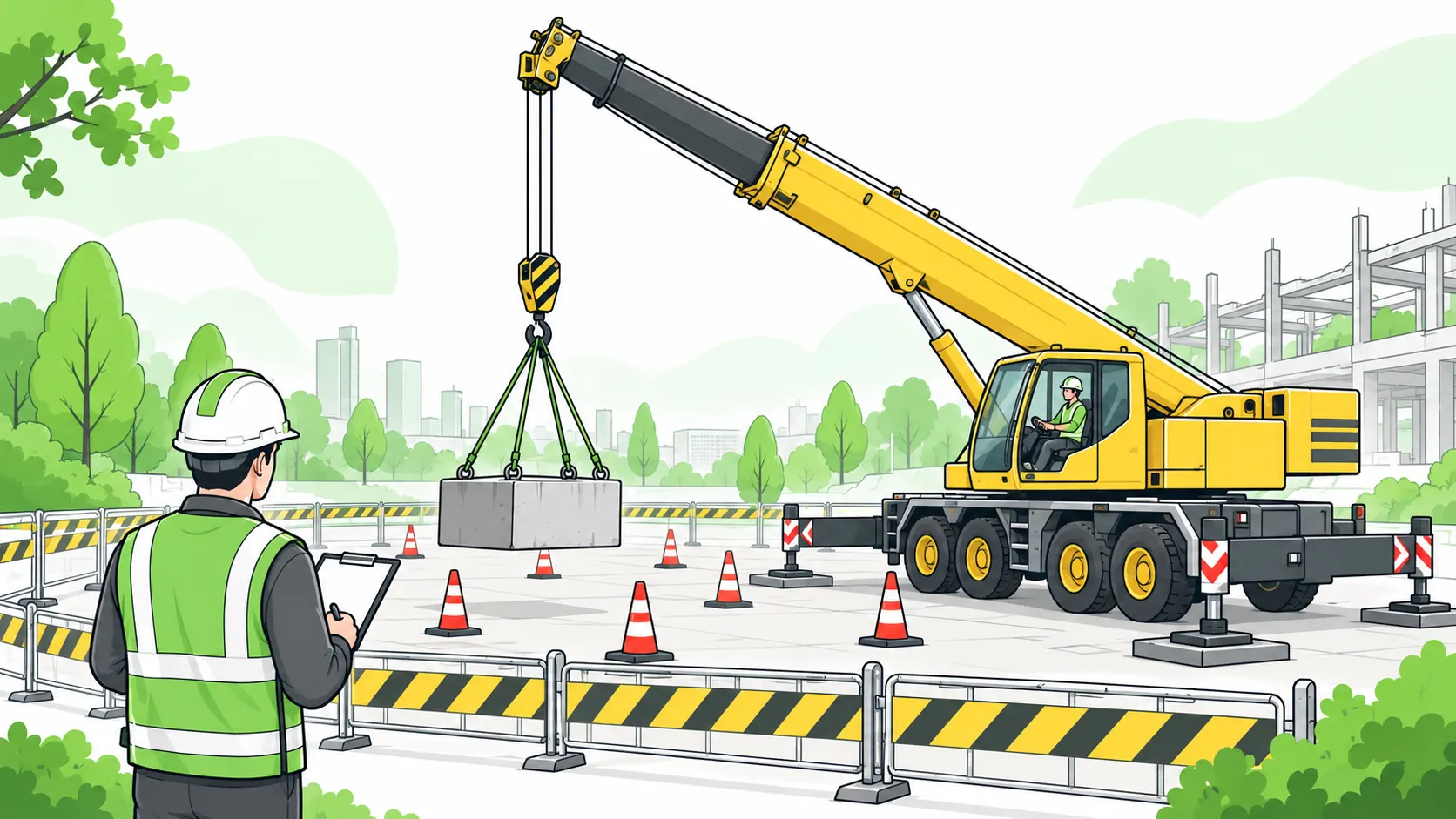
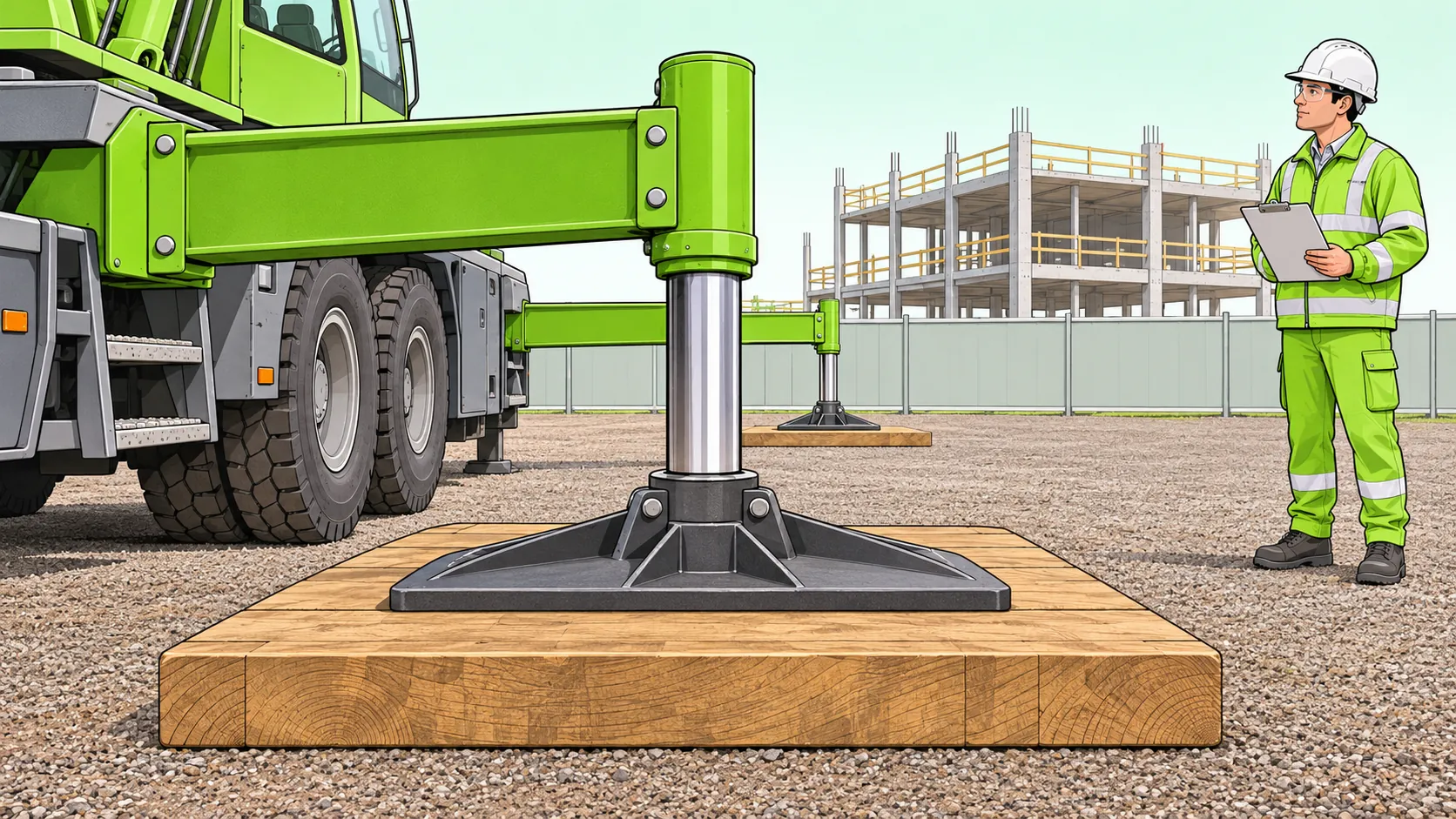
Before setting a mobile crane on outriggers, check each foot position. Find the largest force the crane can put there, confirm the pressure the ground can safely carry, and select a pad or mat that can spread that force. If the ground capacity is unknown, the mat cannot carry the force, or the crane cannot be set as planned, hold the setup. A level crane can still be standing over a weak layer or a buried void.
Check what lies beneath each outrigger
Mark the proposed foot positions and the edges of the mats on the site plan. Walk those positions with the operator and the person responsible for site preparation. Compare what you see with utility and as-built drawings, recent excavation records and any ground report. Check that the report covers the crane standing area. A borehole or foundation report for another part of the project may describe different ground. Queensland Mobile crane Code of Practice 2024, §§8.2.1–8.2.3.
| Site condition | Decision before setup |
|---|---|
| Soft fill, standing water or a firm surface crust | Obtain an allowable bearing pressure that applies to the footprint and current conditions. Ask a geotechnical engineer to assess doubtful ground, including weak layers and expected settlement. Move to assessed ground or have the working area improved and checked. |
| Trench, excavation edge or recent backfill | Establish where the ground was disturbed. Have the setback checked for the depth, soil condition, water and excavation support. Measure clearance from the nearest edge of the supporting mat. Widening the mat toward the trench reduces that clearance. |
| Paving above a tank, pipe, pit or unknown void | Keep the setup clear until the buried feature is located and its effect assessed. A wider pad can reduce surface pressure while the cover or ground underneath still collapses. |
| Suspended slab or deck over a basement | Give the structural engineer the foot locations, maximum forces and proposed mats. Obtain the permitted positions and any propping instructions in writing. Check that the supports are in place at the specified locations before loading the slab. |
Rain, groundwater or excavation since a ground assessment can change its findings. A hard, dry crust can conceal saturated material. WorkSafe Queensland also flags hidden cavities on dewatered sites and calls for engineering advice on where and how to test. WorkSafe Queensland, Safe support of mobile plant on outriggers.
For U.S. construction work covered by the Occupational Safety and Health Administration (OSHA) crane standard, the controlling entity must arrange the necessary ground preparation and tell the equipment user and operator about subsurface hazards it knows of or can identify from records it holds. The ground, with supports as needed, must be firm, drained and graded enough for the manufacturer’s support and level requirements. The drainage provision has an exception for marshes and wetlands. If there is no controlling entity, the employer authorized to arrange ground preparation takes on that preparation duty. OSHA 29 CFR 1926.1402(b)–(d).
Find the maximum load on each foot
An outrigger reaction is the force the crane transmits through one foot. As the boom swings, that force shifts between feet. Dividing the combined weight of the crane and load by four can seriously underestimate the most heavily loaded foot. The crane’s rated lifting capacity tells the operator what it can lift in a configuration. The lift planner also needs the reactions for that configuration. U.S. Navy Crane Center, General Crane Safety Student Guide, p. 66.
- Identify the crane model, boom and jib, counterweight and extension of each outrigger beam. Use the manufacturer’s reaction data or planning software for that model. Include the load and lifting accessories as the manufacturer specifies.
- Check the full sequence, including pickup, swing, set-down and movements with the hook empty. At a short radius with a high boom, the counterweight can produce the peak reaction even with nothing on the hook.
- Record the governing reaction for each support position on the setup plan. If the crew changes the radius, counterweight, outrigger spread or swing sector, have the planner check the reactions again before proceeding.
The load chart and the reaction calculation must describe the crane that will actually be on site. Manitowoc publishes separate pad-load calculators for different crane models. If the available data do not cover the planned setup, obtain the values from the crane supplier or a qualified lift engineer. Manitowoc Outrigger Pad Load Calculators. Queensland Mobile crane Code of Practice 2024, §§8.2.6–8.2.7.
Calculate the bearing area and check the mat
Use the maximum reaction for the foot and the allowable bearing pressure for its location. Ask for the pressure permitted for the planned work. If the report gives only the soil’s ultimate capacity, ask the geotechnical engineer for the allowable pressure. Ultimate capacity describes failure. Excessive settlement can govern the allowable pressure at a lower load. Federal Highway Administration, Shallow Foundations, §§5.1–5.2.
Minimum effective bearing area (m²) = maximum outrigger reaction (kN) ÷ allowable ground pressure (kPa). This preliminary calculation assumes uniform pressure over the effective area. A kilopascal is one kilonewton per square metre. With U.S. units, divide pounds-force by pounds-force per square foot to obtain square feet. For a rectangular mat, length times width gives its full footprint. Use only the portion that will carry load. Divide the reaction by that effective area and check that the resulting pressure is within the site limit. Queensland Mobile crane Code of Practice 2024, §8.2.7, option 2.
Check what the mat can actually carry. Obtain the mat supplier’s rating or an engineer’s design for the foot size, reaction and support arrangement. A thin mat can bend under the foot and concentrate the force over a smaller area. Check thickness, material and condition, and confirm the mat can resist crushing under the foot, bending and shear. Credit only the area the mat can load effectively. Where the required mat cannot fit or cannot bear evenly, change the position or obtain a designed support arrangement. Crane Stability and Ground Pressure, §4.2.
Match the field setup to the plan
Have the operator and crew check the physical setup against the approved configuration before taking a load. For U.S. construction work, OSHA sets specific requirements for beam extension, floats, visibility and blocking. OSHA 29 CFR 1926.1404(q).
- Place the specified pads or mats on the prepared surface. Check for damage, make sure each mat bears evenly, and center the foot where the support arrangement calls for it. For a jack-equipped outrigger, place blocking beneath the float. A beam designed without a jack bears at its designated outer bearing surface.
- Extend the beams fully or use the manufacturer-permitted position shown on the applicable load chart. Set and secure each assembly according to the manual, with each leg visible to the operator or a signal person during extension and setting. Attach the floats where they are used.
- Follow the equipment’s wheel-support instructions. For the mobile cranes on outriggers discussed here, OSHA requires taking the equipment’s weight off the wheels. Its wheel-unloading provision does not apply to stabilizers. Check level against the manufacturer’s tolerance and verify the load chart matches the actual beam positions before lifting.
Include the setup drawing and any restrictions in the lift briefing so the crew knows which changes require another check. The briefing also covers signals, responsibilities and the load path as part of the safe work procedure for crane operation.
Recognize movement and stop the lift
A competent person must begin OSHA’s visual inspection before each shift the crane will be used. It includes checking for settlement around supports and water accumulation. Check the crane’s level before each shift and after each move and setup. Reassess the findings if conditions change during operation. OSHA 29 CFR 1926.1412(d)(1)(x)–(xi).
Warning. A sinking foot or shifting mat can tip the crane. If a mat moves, the ground yields or the crane starts to lose level, signal a stop, keep people clear and have the operator follow the crane’s safe-stop procedure. Monitor the supports from a safe position throughout the operation. WorkSafe Queensland guidance on monitoring outriggers.
If the operator or assembly/disassembly director finds the ground inadequate, their employer must discuss the necessary preparation with the controlling entity. Correct the cause, recheck the support and crane configuration, and brief the crew on any change. OSHA gives the operator authority to stop and refuse loads until a qualified person determines it is safe to resume. OSHA 29 CFR 1926.1402(e) and 1926.1418.