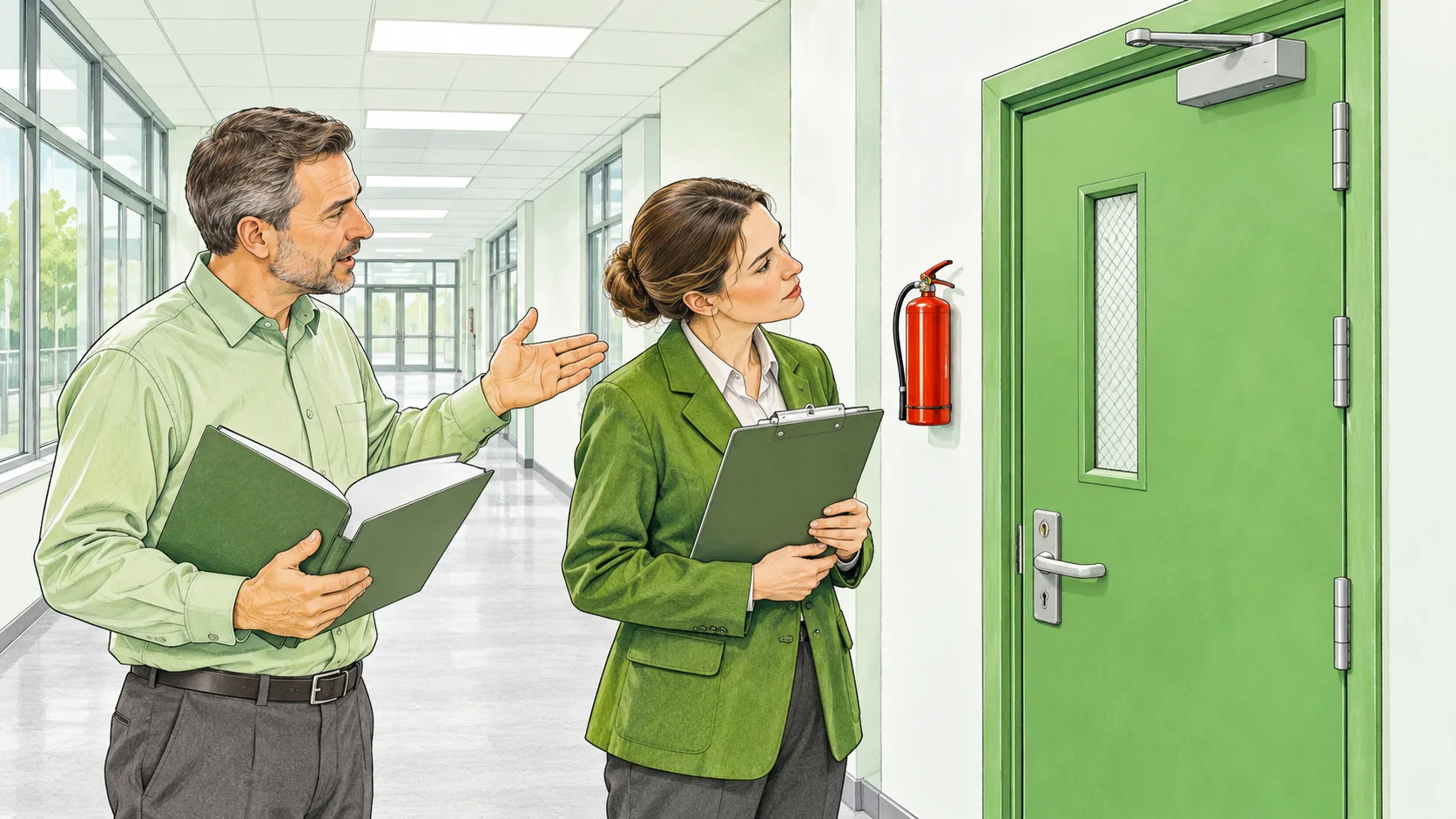
In England and Wales, the Responsible Person can carry out the fire risk assessment, use someone in their organisation or appoint an external assessor. The choice depends on whether the person doing the work can identify the risks to people in these premises and judge whether the precautions are adequate. For a straightforward workplace, someone in-house may have the necessary knowledge and experience. For premises where people sleep, need help to escape or depend on a complex fire strategy, ask for evidence of assessments involving those same demands.
Who holds the duty, and does the assessor need a licence?
Under article 9 of the Regulatory Reform (Fire Safety) Order 2005, the Responsible Person must ensure there is a suitable and sufficient assessment. In a workplace, the employer is the Responsible Person if it controls the workplace to any extent. Elsewhere, responsibility depends on who controls the premises in connection with their undertaking, or on ownership in the circumstances set out in article 3. More than one party can have duties in a shared building. A consultant can inspect, evaluate and report. Appointing one leaves the Responsible Person’s own duty in place. Fire Safety Order, articles 3, 5, 9 and 22.
The Order covers workplaces and other premises within its scope, including the common parts of buildings containing two or more domestic premises. The inside of an ordinary private dwelling is generally outside that scope. In a shared building, identify who controls each part and who controls common escape routes, alarms and other building-wide measures. Give the assessor a named contact for those arrangements. Welsh Government guidance on cooperation between Responsible Persons.
Legal position at 24 November 2026. The Fire Safety Order does not prescribe one qualification, register or licence for everybody who carries out an assessment. Article 18 already addresses competent assistance with preventive and protective measures. A separate amendment would expressly require competence when appointing someone to make or review the assessment itself. The provision introducing that new article 9A, section 156(4) of the Building Safety Act 2022, has yet to come into force in either England or Wales. England’s 2026 consultation on mandatory certification is a separate proposal. The existing article 9 duty applies now. Building Safety Act 2022, section 156 and its commencement notes, and England’s consultation on the fire risk assessor profession.
Can you or a member of staff assess the premises?
Start with what the building demands. An internal assessor may know the shift patterns, equipment and escape routes well. They also need enough fire safety knowledge to recognise where the existing arrangements could fail. Give them time to inspect the premises, speak to people who use them and examine the records. England’s Home Office guidance recognises self-assessment for suitable premises and stresses that experience must match the work. Home Office guidance for duty holders, sections 3.1–3.18.
Ask the proposed assessor to explain the following in relation to the building they will inspect.
- Who could be harmed? Can they account for staff, visitors, contractors, people unfamiliar with the premises and anyone who may need assistance? Do they know how occupancy and staffing change after normal hours?
- How would fire and smoke affect escape? Can they identify likely ignition sources and combustible materials, trace escape routes and judge how doors, walls and other barriers protect those routes? Can they explain how the alarm and evacuation arrangements work for the people who depend on them? Those questions test whether the assessor understands the building's fire protection levels — the passive barriers, active systems and procedural plans that must work together.
- How would they check their conclusions? Ask which areas they would inspect, which maintenance and test records they would need, and what they would do if the plans differed from what they found. A sound answer distinguishes an observed fact from an assumption.
- Where would they need help? Ask what would prevent them reaching a sound conclusion and who could resolve the uncertainty. A need for specialist input should be identified while the scope and budget can still be adjusted. North Wales Fire and Rescue Service guidance on assessor knowledge and limits.
If the internal candidate can answer these questions and demonstrate comparable work or the ability to apply appropriate premises guidance, self-assessment or an in-house appointment may be reasonable. If they cannot explain a critical feature of the escape strategy, commission someone with that competence. An employee can still help by arranging access, explaining how the building operates and following up actions.
Match qualifications and experience to the building
British Standard BS 8674:2025 provides a framework for judging the competence of individuals who carry out general life-safety fire risk assessments in occupied buildings. It describes Foundation, Intermediate and Advanced competence. Use these levels to discuss the difficulty of the assignment, including who occupies the building, how they receive warning and how they escape. A building’s size or an assessor’s job title alone cannot settle that decision. British Standards Institution overview of BS 8674:2025.
| Competence level | Premises and task | What the assessor should be able to show |
|---|---|---|
| Foundation | Simple, low-risk premises with straightforward occupancy and escape. | How they inspect the space, identify people at risk, check routine precautions and set out the actions needed. |
| Intermediate | Premises of moderate complexity, including more varied uses or arrangements. | Comparable work showing how they evaluated different occupancies, shared routes or interacting precautions, and how they reached their conclusions. |
| Advanced | Complex or high-risk premises, particularly where evacuation depends on staff, multiple systems or a building-specific strategy. | Recent assessments of premises with those features, how they tested the assumptions behind the strategy, and where they sought specialist advice. |
For a qualification, ask for its full title, awarding body and what the candidate had to demonstrate. The SFJ Awards Level 4 Diploma in Fire Risk Assessment, for instance, is designed to develop capability at the Intermediate level of BS 8674. Follow that evidence with a question about a comparable assignment the individual has completed. A course attendance certificate, years of service or a former fire-service role supplies little information about the assessments the person has actually carried out. Level 4 Diploma qualification specification.
Set a boundary around specialist work. A general assessment may identify a concern about smoke spread through an external wall. Where the evidence warrants a specialist wall appraisal, ask the assessor to describe the concern, the information needed and the competence required for that follow-up. A visual assessment alone cannot establish how concealed materials will perform. BS 8674 also puts fire engineering design and intrusive investigation outside its scope. Government guidance on assessing external-wall risk.
How to check a named assessor before appointment
Give prospective assessors the same description of the premises, occupants, fire strategy, access arrangements and known concerns. Request a proposal naming the person who will visit, the person who will write the report and anyone who will review it. This lets you compare what each quotation buys and check the people who will actually do the work. National Fire Chiefs Council guidance on selecting an assessor.
- Verify the qualification and registration claims. Check the qualification against the awarding body’s specification. For a register or certification claim, check the current entry with the scheme operator. Match the name, type of work and scope to the proposal. Where the claim relates to a business, ask how it selects and supervises the named assessor. BAFE SP205, for instance, provides third-party certification of an organisation for life-safety fire risk assessment. The company’s listing alone does not show the individual’s experience of your building type. BAFE SP205 registration and certification process.
- Examine comparable work. Request a recent anonymised assessment the individual worked on and ask which parts they completed. Look for a finding tied to an actual location, the people affected, the reason it matters and a prioritised action. Ask why the assessor chose that action and how they treated an area they could not inspect. A sample full of standard answers is weak evidence of judgement.
- Check a reference and current practice. With permission, contact a client whose premises presented similar risks. Ask who attended, whether important issues were explained promptly and whether the client could act on the report. Ask the assessor about recent training or professional development relevant to your building and how it has changed their work.
- Test the scope of the offer. Ask what is excluded, who checks technical quality, how concerns or complaints are handled and how any interest in selling remedial work is disclosed. Check that professional indemnity insurance covers the proposed service and premises. Record the checks, any gaps and why you chose the assessor. If the gap concerns a critical part of the job, obtain further evidence, add the right specialist or choose another assessor before commissioning the work.
Agree what the assessor will deliver and what happens next
Put the premises, areas, operating conditions and deliverables in the appointment. Arrange access to the people, plans, previous assessments, maintenance records and fire strategy the assessor will need. Agree how an urgent finding will reach the person able to act during the visit, how inaccessible areas will be recorded and who will commission any further investigation. A quotation that leaves essential areas out needs a revised scope or a clearly assigned follow-up.
At handover, ask the assessor to take you through the most important findings. The report should identify who could be harmed, explain the precautions already in place, prioritise further action and state the limits of the inspection. Resolve unexplained assumptions or omissions before treating the assessment as complete. Give each action an owner and a timescale, and check that it has been carried out. Government guidance on assessment findings and action plans.
Keep the full assessment or review and the fire safety arrangements. Record who assisted, including the organisation where applicable, alongside your evidence for the appointment. Coordinate relevant findings with other Responsible Persons and review the assessment when changes or new evidence affect its validity. This includes deciding when to review a fire risk assessment as the building or its occupants change. Government guidance on recording fire risk assessments and responsibilities.