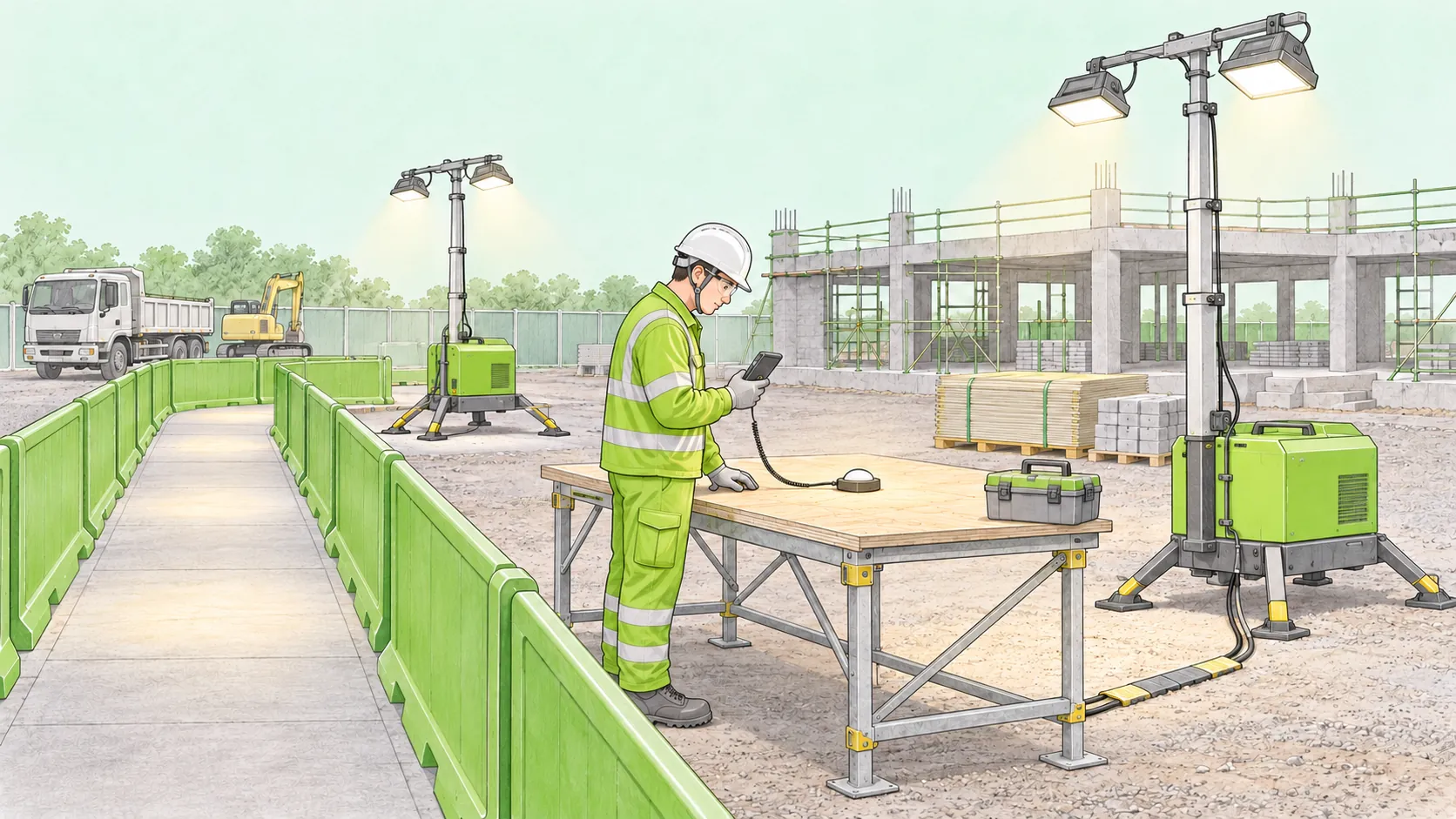
Before an outdoor night shift starts, check whether the crew can see the work, drivers can see people approaching a crossing and everyone can find a safe way out if the lights fail. Set the lighting level for each area and task, position the lights, then verify the result after dark with a light meter and a walk through the site. Hold any operation where glare, shadows or inadequate light still hide a hazard.
Choose the lighting level for each part of the site
Mark the work positions and the routes between them on the shift plan. A concrete placement area, a batch plant and a first aid station can all be outdoors on the same project and have different lighting requirements. Identify the activity at each point before selecting lamps or ordering towers.
For construction covered by US federal Occupational Safety and Health Administration (OSHA) rules, 29 CFR 1926.26 requires natural or artificial light where work is in progress. Section 1926.56(a), Table D-3, gives minimum illumination in foot-candles. The following entries are relevant to outdoor projects. Check the full table for other settings, and check any applicable state-plan and project requirements. OSHA construction illumination rule and Table D-3.
| Area or operation in Table D-3 | Minimum (foot-candles) |
|---|---|
| General construction area lighting | 5 |
| Listed work areas and operations, including placing concrete, excavations, waste handling areas, accessways, active storage, loading platforms, refuelling and field maintenance | 3 |
| Construction plant and shops, including batch and screening plants | 10 |
| First aid stations, infirmaries and offices | 30 |
The first two rows of the federal table use similar terms. One assigns 5 foot-candles to general area lighting. The next lists “general construction areas” alongside the named operations at 3. Match each location to the published entry. Where the classification is uncertain, resolve it with the project safety lead before relying on the lower figure. Even a reading above the applicable minimum can leave a worker unable to see a mark or a driver unable to distinguish a person in glare.
In Great Britain, construction sites, their approaches and their traffic routes must have suitable and sufficient lighting, using natural light so far as reasonably practicable. The colour of artificial light must preserve how safety signs and signals are perceived. This regulation also requires secondary lighting where failure of the primary artificial light would put someone at risk. It sets no single numerical target for outdoor work. Construction (Design and Management) Regulations 2015, regulation 35.
Lay out floodlights, task lights and routes together
Start at the crew’s entrance and follow the shift in order, including setup and clearing away. On the plan, mark the gate, walkways, changes of level, vehicle crossings, work faces, controls, material stacks and escape routes. Decide where extra light will be needed as a machine moves or the job advances. Give someone on the shift authority to move the work boundary or pause the job until the lighting catches up.
- Light the route continuously. Stand at decision points along the route and check the next turn, step or barrier. Cover the far side of a parked vehicle and the transition from a bright work area into a dim yard. Keep stands and leads out of the walking space. Give particular attention to the places where pedestrians emerge into drivers’ view. Health and Safety Executive guidance on transport lighting.
- Light the work from a usable angle. Use broad illumination for the working area. Add a local lamp where hands, an attachment or the worker’s own body block the view. Check the working face from the position in which the person will actually use a tool, read a scale or inspect a joint. Choose the angle that reveals the detail without putting a bright reflection in the worker’s eyes. The comparison of task lighting and general lighting explains how to use the two together.
- Keep beams out of lines of sight. Aim and shield floodlights so the beam falls on the intended surface. Check the view back towards the lights as well as away from them. Re-aim, shield or reposition a fitting if glare masks movement or a hard shadow hides a step. Check again from the opposite direction after making the adjustment. Health and Safety Executive guidance on shadowed areas and safety signs.
At vehicle crossings, verify that the pedestrian can see an approaching vehicle and that the driver can recognise someone waiting to cross. Keep the barriers, designated crossings and vehicle controls in place. Lighting improves visibility but leaves the risk of a collision if both users are sent into the same path. Review these interfaces when planning pedestrian and vehicle routes.
Set up towers and temporary power safely
Warning. An overhead line can kill someone handling a light tower. Keep the mast and its entire travel path clear of power lines. If safe clearance is uncertain, leave the mast down and have the site team resolve the location with the line owner before setup.
The New York State Fatality Assessment and Control Evaluation program investigated a mechanic’s electrocution after a mobile light tower contacted a power line. Nobody witnessed the incident, and investigators could not establish why the mast was extended. They found that the lighting plan had missed the overhead hazard and recommended surveying tower locations before placement. Fatality investigation and recommendations on mobile light towers.
Choose tower positions in daylight where possible. Allow room for the base, stabilisers, equipment access and the full movement of the mast. Keep the equipment clear of haul routes and survey for overhead lines before agreeing the position. Check the particular tower’s operating instructions for permitted ground conditions, levelling, stabilisers, wind limits and its travel position. Those limits depend on the equipment. Mobile light tower operator’s manual, work area safety.
Have the person responsible for temporary electrics confirm that the supply, fittings and connectors suit the conditions. Protect cables from being cut, pinched or driven over. Mount lamps securely and protect general lighting lamps from contact or breakage. Under US federal construction rules, a temporary light may hang by its cord only if both are designed for that purpose. Fittings in wet or damp locations must be identified for that use and installed to keep water out of electrical parts. Remove damaged equipment from use. OSHA temporary wiring and lighting requirements, paragraphs (a)(2) and (j)(1).
Site a fuel-driven generator outdoors where its exhaust cannot enter doors, windows, air intakes or an enclosed work area. Plan refuelling or charging before the crew loses light. If a shutdown is needed, arrange an alternative supply or stop the affected work first. OSHA guidance on portable generators.
Measure the light and check what people can see
Lumens on a lamp describe its light output. A meter measures the light arriving at a surface, called illuminance. Distance, aim, obstructions and the condition of the fittings affect the reading. Use a suitable light meter with its calibration checked, select the units used in the plan and take readings under the lighting that will actually serve the shift. One foot-candle is approximately 10.76 lux. OSHA interpretation on measuring light at the work surface and National Institute of Standards and Technology unit conversion.
- Measure at the work. For a horizontal work surface, take the reading with the sensor facing up at the working height. Check ground-level routes at the surface being used. For detail on a vertical face, check the light falling on that face as well. Hold the sensor parallel to the face being checked and keep your body from casting an unintended shadow across it. US Department of Energy lighting measurement protocol, appendix A.
- Look for the low points. Check each separate work location, including edges, crossings, steps and the gaps between towers. Record the location, task, units, reading and applicable target. A bright reading beside a tower cannot establish the level at the far end of a walkway. Transportation field research on measuring nighttime work areas, page 68.
- Check the view during the operation. Ask workers to check the detail from their working positions and drivers to check the approach from the cab with the vehicle safely stationary. Look for moving shadows, reflections from wet surfaces and glare that makes a person disappear against the background. Verify that signs, signals and emergency equipment are distinguishable.
- Correct and recheck. Keep the affected activity on hold where the reading is below its governing minimum or the crew cannot see safely. Adjust the beam, add local lighting or change the work position. Repeat both the meter reading and the visibility check, including from any neighbouring route the change could affect.
For US road work, check the applicable temporary traffic control plan and road authority requirements. The Federal Highway Administration’s Manual on Uniform Traffic Control Devices recommends driving through the floodlit area at night from every approaching direction after initial setup and periodically afterwards to check glare. Its standard requires lighting at nighttime flagger stations except in emergencies. Designate someone to make that check without exposing a worker on foot to live traffic. Manual on Uniform Traffic Control Devices, section 6M.08.
Prepare for a lighting failure and hand over changes
Before the shift, identify what a single lamp, tower or power-supply failure would leave in darkness. Check the route from the work face to a place of safety, including changes of level and any crossing. Arrange secondary lighting wherever a loss of light would put people at risk. Check that it will still work when the normal supply fails. Workers should know whom to call, what to stop and how to leave without stepping into moving traffic.
Escape lighting needs to show the way out. Its presence does not establish that there is enough light to continue lifting, cutting or vehicle movements. On a failure, stop the affected operation safely, protect the darkened area and use the agreed exit route. Have the fault dealt with and repeat the visibility and level checks before restarting. Health and Safety Executive guidance on emergency lighting and escape routes.
At handover, tell the incoming supervisor which areas were checked, where lights were repositioned, which routes or tasks remain restricted and who will release them. Repeat the affected checks when the work face advances, plant or stock blocks a beam, weather changes visibility or a fitting goes out. A reading from the start of the night describes only the arrangement that produced it.