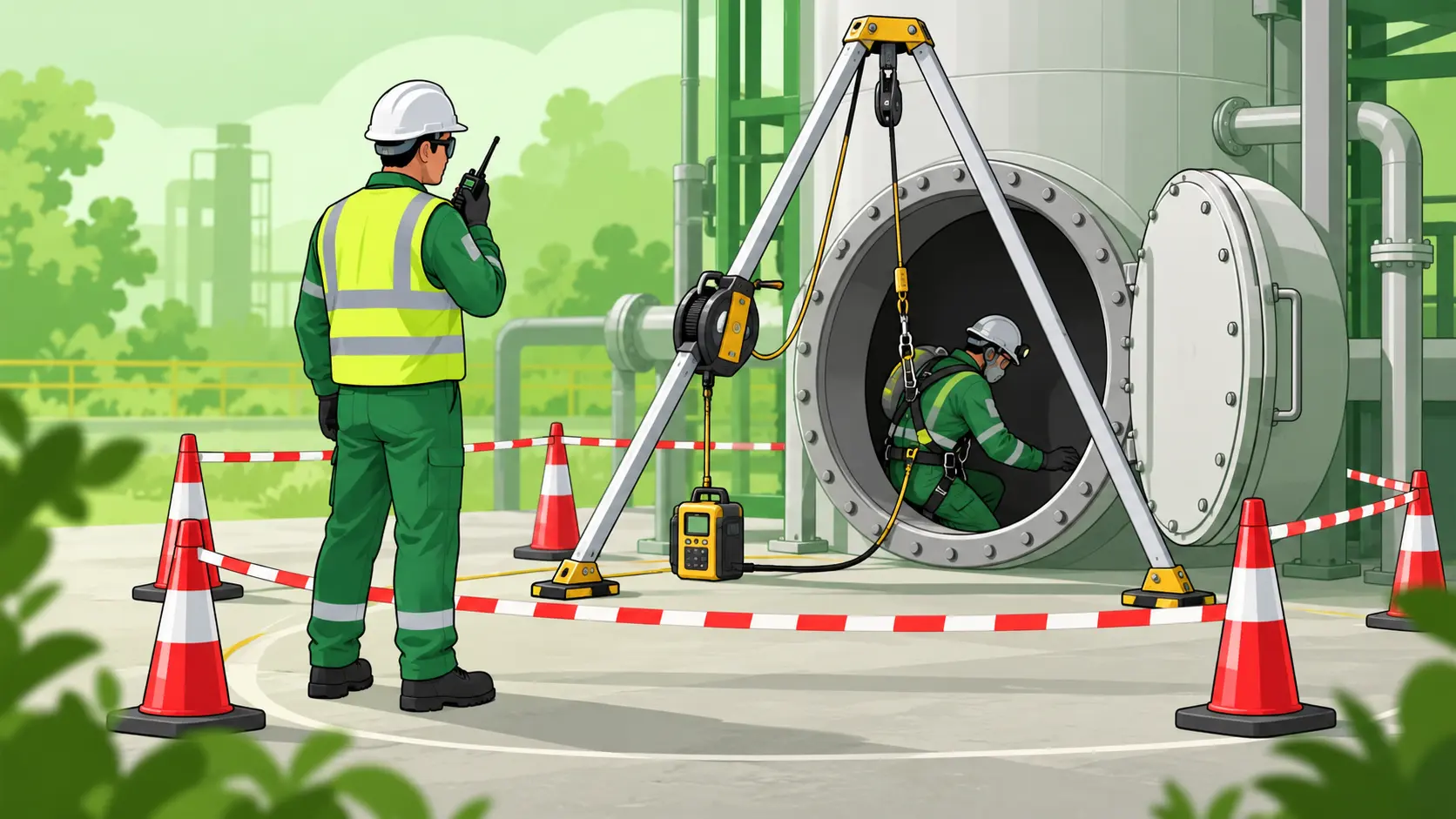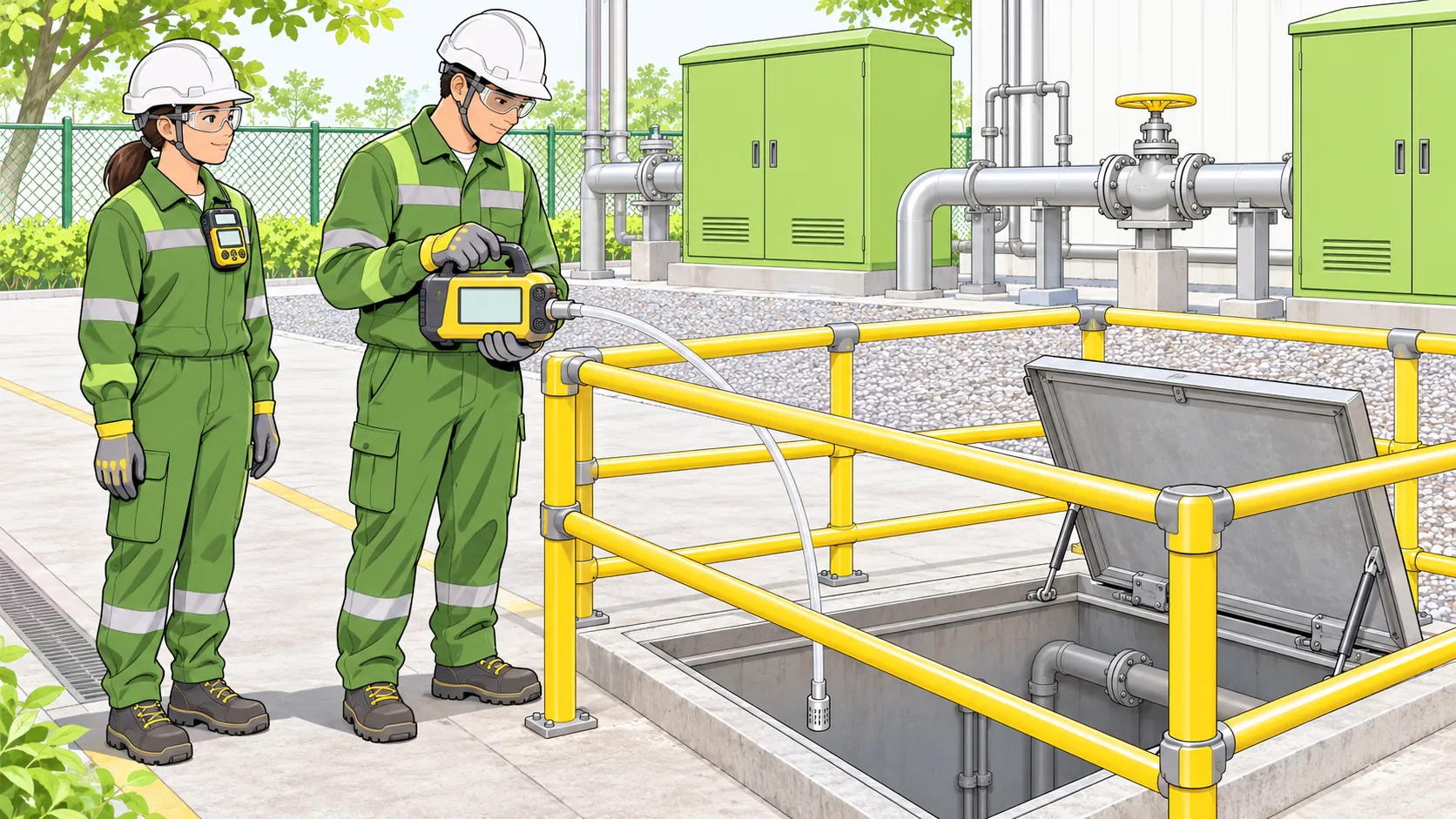
Use a spot gas test when the decision concerns a particular gas, place and time. Use continuous monitoring when people need warning of a change while they work, or when the applicable rule requires it. Periodic checks can be appropriate if the rule permits them and the employer can show that the interval gives workers enough warning. On a confined-space entry, the crew will often need both a pre-entry survey and monitoring throughout occupancy.
What does each method tell you?
The difference is what happens after the tester takes the reading. A portable meter can take spot readings at several points, or it can stay at one point and monitor continuously. The sensor, its location and the time it takes to respond limit what either result can tell you.
| Method | Decision it can support | What it can miss |
|---|---|---|
| Spot test | Screen for a known contaminant at a specified sampling point, or take one of the readings needed for a pre-entry survey. | A pocket elsewhere, a gas outside the instrument’s range or a release after the sample. |
| Periodic checks | Recheck defined points during work when repeat sampling is permitted and the interval has a defensible basis. | A release that begins and clears between checks, or one that becomes dangerous before the next check. |
| Continuous monitoring | Follow changes at a worker or a fixed point and warn people in time to act when a specified threshold is reached. | A release that misses the sensor, a substance it cannot detect, or a change faster than the detection and warning system can handle. |
A spot test can be enough to decide whether a known vapor warrants further investigation. Select a detector tube with the sensitivity and range to answer that question at the sampling point. The result applies to the air drawn through that tube. A short sample cannot establish a worker’s average exposure over a shift. The U.S. Occupational Safety and Health Administration (OSHA) explains these uses and limitations in its Technical Manual, section II, chapter 3, “Detector Tubes.”
When do U.S. confined-space rules require continuous monitoring?
Identify the industry and entry procedure before selecting a monitoring interval. The federal OSHA rules below cover permit-required confined spaces in general industry and construction. In both, the employer must establish acceptable entry conditions. An acceptable pre-entry reading is one part of that decision.
- General-industry permit entry. Test before authorizing entry. During the job, test or monitor often enough to determine that acceptable conditions continue. If isolation is infeasible because the space is large or belongs to a continuous system such as a sewer, test beforehand to the extent feasible and continuously monitor conditions where entrants work. 29 CFR 1910.146(d)(5)(i)–(ii)
- Construction permit entry. Ordinarily, test before changing natural ventilation and before authorizing entry. Continuously monitor atmospheric hazards during entry unless the employer demonstrates that continuous equipment for the hazard is commercially unavailable or that the proposed checks will be frequent enough to verify that controls keep the hazard at safe levels. In either exception, periodic monitoring must be frequent enough to verify acceptable entry conditions. 29 CFR 1926.1204(e)(1)–(2)
- Construction where isolation is infeasible. A narrower rule applies if the employer demonstrates that the space cannot be isolated because of its size or connection to a continuous system. Test beforehand to the extent feasible and continuously monitor entry conditions where entrants work. For an atmospheric hazard, periodic monitoring is allowed here only when the employer demonstrates that continuous equipment for that hazard is commercially unavailable. A separate continuous early-warning system is required for a non-isolated engulfment hazard. 29 CFR 1926.1204(e)(1)(i)–(iii)
What changes if the crew uses forced ventilation? Running a fan does not, by itself, qualify an entry for alternate procedures. Where the general-industry employer meets the conditions in 1910.146(c)(5), including demonstrating that the only hazard is atmospheric and that continuous forced ventilation alone keeps the space safe, it must test periodically as necessary to verify that ventilation remains effective. General-industry alternate procedures, 1910.146(c)(5)(i) and (ii)(C)–(G)
For construction, the employer must also show that engineering controls have eliminated or isolated all physical hazards and that workers can exit safely if ventilation stops. Even under this alternate procedure, monitoring is continuous unless the entry employer demonstrates that continuous equipment is commercially unavailable or periodic monitoring is sufficient. If an exception applies, periodic monitoring is still required. Both alternate procedures require pre-entry testing with a calibrated direct-reading instrument. Construction alternate procedures, 1926.1203(e)(1)–(2)
How to decide whether periodic checks are enough
Start with the person furthest from the exit. A useful interval allows enough time for a change to be detected, for the warning to reach that person and for them to get out. An interval copied from another permit needs to be justified against the hazards and exit route on this job. OSHA expressly requires construction entry employers to consider whether their monitoring will give entrants time to escape if ventilation fails. 29 CFR 1926.1204(c)(5)
- Identify what could change the air. List the previous contents, residues, connected lines, substances brought in and gases the work could produce. Include a loss of ventilation and work taking place nearby. Establish which sources have actually been isolated and which still need watching.
- Look for evidence that conditions will stay within the limits. Use representative readings from the same task, configuration and controls. Record where they were taken, over what period, and whether the work was already underway. A set of readings taken in an empty, freshly ventilated space says little about the air once cleaning or welding starts.
- Compare the sampling gap with the time available to act. Consider a release just after a check. Include the wait for the next sample, the travel time through any tubing, sensor response, communication and exit. If an unsafe atmosphere could develop before people can get clear, select continuous monitoring with adequate coverage and warning time. If that too is too slow, improve isolation, ventilation or the work method before proceeding.
- Write down the decision and its limits. Name the gases, sampling points, acceptable readings, check interval, person testing and person receiving the warning. Specify when to pause and reassess, including after a ventilation interruption, a change of task or movement into a new work area. If a scheduled check is missed, pause the work and restore the agreed coverage. A broken instrument is a loss of protection.
In Great Britain, the Health and Safety Executive’s (HSE) Approved Code of Practice recommends continuous monitoring, for example, where forced ventilation is in use or the activity could change the atmosphere. It calls for a competent person to define the testing and retesting arrangements for the job. HSE L101, paragraphs 89–92
Sample where the hazard and the worker can meet
A continuous detector at the hatch can read normally while the atmosphere at the far end is hazardous. For pre-entry testing, sample the approach, work positions and pockets that ventilation may not reach. Use a suitable probe from outside where practicable. Moving a probe too quickly can make the display at one point look like a reading from the next. HSE L101, paragraphs 97–98
- Match the sensors to the substances. Identify the gases and vapors the task can produce and compare their limits with the instrument’s range, sensitivity and potential interferences. A normal oxygen reading leaves the toxic-gas question open. Under both U.S. permit-space rules, test oxygen first, combustible gases and vapors second, and toxic gases and vapors third. Some combustible-gas sensors need sufficient oxygen to give a reliable reading. OSHA Appendix B, atmospheric testing procedures
- Give each sample time to reach and register on the instrument. Follow the manufacturer’s instructions for the target substance, tubing material and length, pump and sensor. Check for restricted flow. At each new point, allow the air already in the line to clear and the sensor to respond. HSE investigated a fatal explosion after a detector missed flammable vapor before hot work. Investigators identified instrument selection and setup errors, but found that the main reason for the missed reading was vapor clinging to the tubing before it could reach the detector. HSE safety alert on sampling-tube selection
- Choose coverage for the work itself. A personal monitor with its inlet unobstructed near the breathing zone follows the wearer. A fixed sensor stays at its selected point. For a fixed flammable-gas detector, consider likely leak paths, ventilation and worker positions. Use additional points or personal monitoring where the fixed sensor cannot represent the work area. HSE guidance on fixed flammable-gas sensor placement, paragraphs 52–60
Set alarm levels to match the hazards and the action required by the work plan. A combustible-gas channel measures a fire hazard and cannot establish that a vapor is below its toxic exposure limit. For background on the different sensors, see how confined-space gas detectors work.
Before relying on either method, verify that the instrument and its alarms pass the pre-use checks for that model. A bump test checks response to gas and alarm operation. A calibration check compares the indicated concentration with a known value. See OSHA’s direct-reading monitor bulletin and HSEBlog’s explanation of the difference between bump testing and calibration.
What to do when the monitor alarms or coverage is lost
Agree before work who will hear or see the alarm, who will notify the attendant and how entrants will leave. Include shifts when a control room has fewer staff. A display that records a peak for later download gives no warning to a crew that cannot see it. The time needed to relay a remote warning counts toward the time available to escape. OSHA’s interpretation on centralized permit-space monitoring
Warning. If an evacuation alarm sounds, a prohibited condition occurs, a worker develops warning signs or symptoms, or the attendant or supervisor orders evacuation, leave the permit space as quickly as possible. Alert the attendant. Do not stay inside to silence the alarm or take a spot reading to challenge it. General-industry entrant duties, 1910.146(h)(4)–(5), and construction entrant duties, 1926.1208(d)–(e).
If the pump stalls, a required sensor faults or the warning link fails, treat the required monitoring as unavailable. Hold entry or withdraw the crew under the entry procedure. From a safe location, have the responsible person identify the cause, restore protection and verify conditions throughout the affected work area. In general industry, the supervisor cancels a permit when a condition it prohibits arises in or near the space. Construction allows suspension or cancellation for a temporary prohibited condition that leaves the space’s configuration unchanged and creates no new hazards, with full reassessment before re-entry. Other prohibited conditions require cancellation. 29 CFR 1910.146(e)(5) and 1926.1205(e).
Record the actual readings, locations, times, instrument, tester and action taken. At handover, tell the incoming crew what changed, which controls were restored and whether entry has been authorized. That gives the next supervisor enough information to decide whether the original testing plan still fits the job.