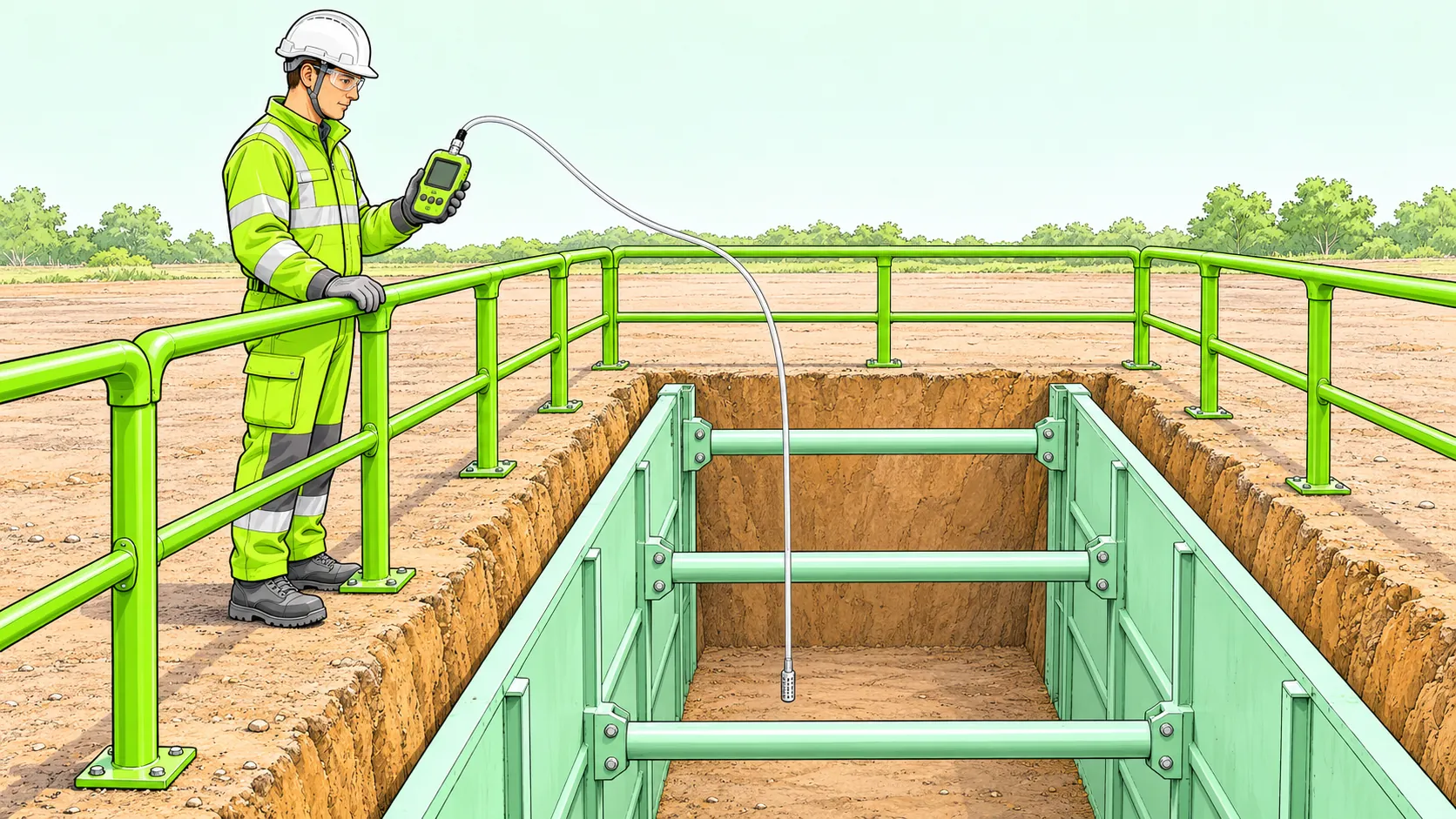
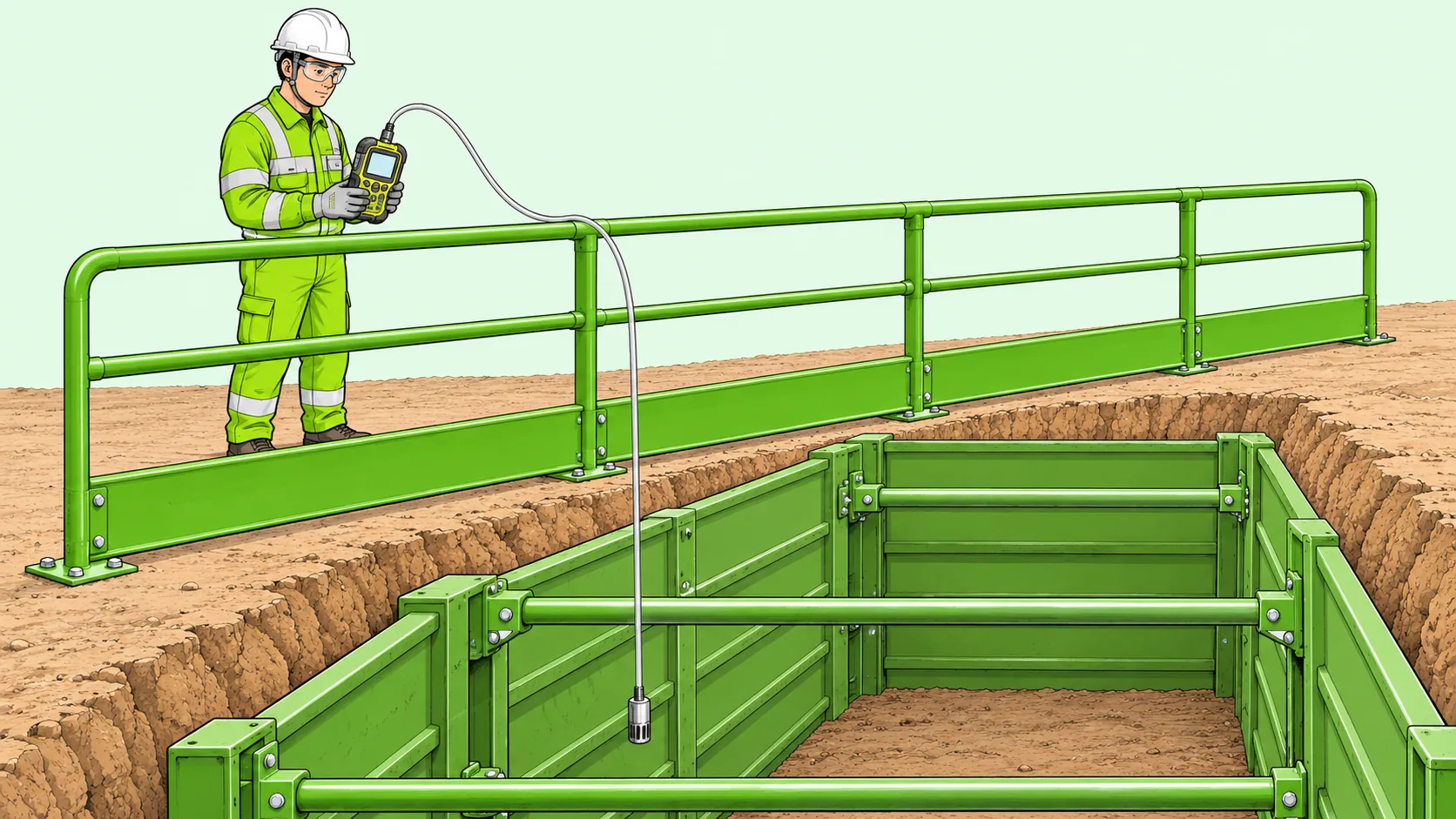
Choose an excavation gas monitor by naming the gases the crew may encounter, then deciding where the instrument must sample them. For a pre-entry check, a pumped monitor with a compatible probe and hose lets the operator draw air from the work position while staying outside the trench. During work, a wearable detector can warn the person exposed as they move. Check the sensors actually installed before issuing either device. A common four-gas meter measures oxygen, flammable gas, carbon monoxide and hydrogen sulfide. Measuring carbon dioxide requires a suitable additional channel or a separate instrument.
Write the equipment brief before choosing a meter
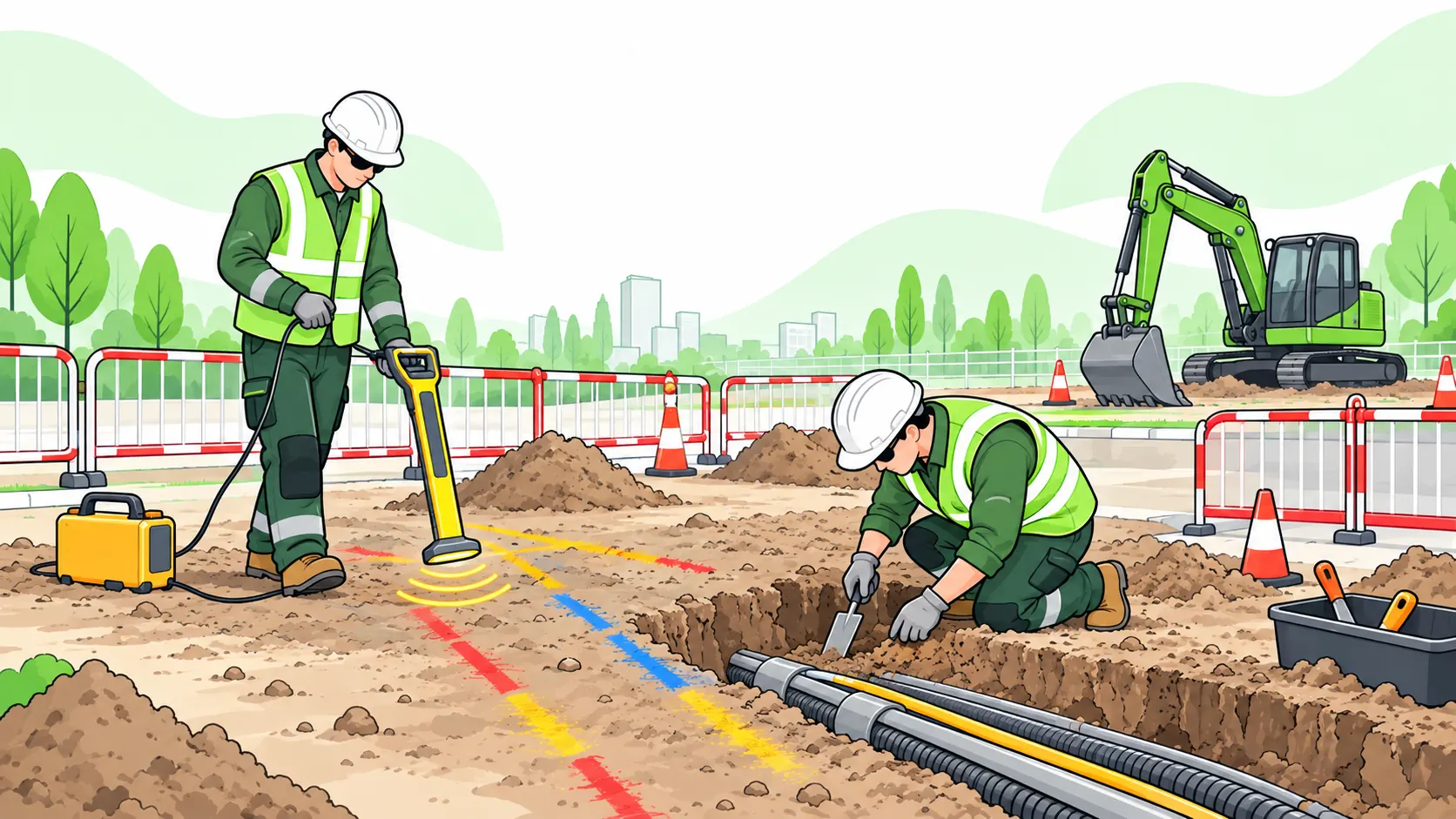
Mark the entry route and work positions on the excavation plan. Identify what could release gas there, including connected sewers, gas services, contaminated ground, nearby engines and the work the crew will do. Beside each source, write the substance to be measured, the decision the reading will support and who needs the warning. Give that list to the person specifying or renting the equipment. “One four-gas meter” leaves most of those decisions to whoever fills the order. OSHA excavation compliance directive, hazardous atmospheres.
For US construction work, the federal Occupational Safety and Health Administration (OSHA) requires testing before employees enter an excavation more than 4 feet deep where oxygen deficiency or another hazardous atmosphere exists or could reasonably be expected. Both conditions matter. The separate duty to take precautions against oxygen-deficient or otherwise hazardous air also matters in shallower cuts. When assessing the job, the competent person needs authority to correct hazards and remove exposed workers. See 29 CFR 1926.651(g) and (k) and the excavation standard’s definition of a competent person.
The depth rule tells you when a test is mandatory under that provision. It does not specify a universal sensor package. Construction work regulated by the excavation standard is excluded from OSHA’s construction confined-spaces rule. Assess any separate entry into a manhole, pipe or other structure on its own facts. For the sequence of the pre-entry survey, see how to test trench air before entry. 29 CFR 1926.1201(b)(1).
Match each foreseeable gas to a sensor and a usable range
Ask to see the sensor list for the actual unit. Even instruments sold under one model name can have different channels. For every gas on the brief, check the measuring range, the smallest change the instrument displays, the accuracy near the action level and any interference expected on this job. One manufacturer lists a hydrogen sulfide sensor with a range of 0–200 parts per million (ppm) and an alternative that reads 0–100 ppm in 0.1 ppm increments. The latter displays finer changes but reaches its upper limit sooner. Check which version will arrive on site. Manufacturer’s published channel configurations and sensor performance specifications.
| What could be present | What to specify | Limit to check |
|---|---|---|
| Oxygen deficiency | An oxygen sensor reading percent by volume. Federal OSHA identifies air below 19.5% oxygen as deficient. | It measures the oxygen remaining. It cannot identify which gas displaced oxygen or rule out a toxic concentration of another substance. |
| Methane or another flammable gas | A combustible-gas channel suitable for the expected fuel, usually displaying percent of the lower explosive limit (%LEL), also called the lower flammable limit (LFL). | Check which gas the unit was calibrated against and how it responds to the expected fuel. A catalytic sensor can under-read in oxygen-deficient air. Review oxygen before relying on its combustible reading. |
| Engine exhaust or sewer gas | A carbon monoxide (CO) channel for CO from combustion and a hydrogen sulfide (H₂S) channel where sewer conditions could release it. Read the toxic channels in ppm. | Each channel measures a particular substance. Consult the sensor’s interference data for other gases that may raise or suppress the reading. |
| Carbon dioxide in landfill gas or from another identified source | A direct carbon dioxide (CO₂) sensor with the needed range. A non-dispersive infrared sensor is one option. | CO and CO₂ require different measurements. CO₂ can reach harmful levels while the oxygen display still looks acceptable. |
| Fuel or solvent vapors from contaminated ground | A photoionization detector (PID) can screen for vapors its lamp can detect. Choose a substance-specific method where the decision depends on one chemical’s concentration. | A PID alone cannot identify the substances in a mixed reading. A low %LEL reading can coexist with a toxic vapor concentration well below the level needed for ignition. |
OSHA’s Technical Manual, section II, chapter 3 explains combustible, toxic and PID sensor limits. The Environmental Protection Agency documents the presence of both methane and CO₂ in landfill gas. OSHA explains the limitation of oxygen-only checks in its carbon dioxide hazard bulletin and describes direct CO₂ measurement in Method 1027.
Check the proposed alarm settings against the site’s actions. Under the federal excavation rule, employers must take precautions to prevent exposure to flammable gas above 20% of its LFL. That is a limit on exposure under this provision, not a recommended first-alarm setting. Set warnings early enough for the crew to act. For a toxic gas, establish whether the criterion concerns a ceiling, a short exposure or a shift average. One spot reading cannot establish a full-shift average. If a credible contaminant has no suitable channel or the ground contamination is unidentified, keep entry on hold while an industrial hygienist or other competent specialist specifies the method. 29 CFR 1926.651(g)(1)(iii).
Choose a remote probe, a wearable detector or an area monitor
Decide where the air must reach the sensor. A pump draws a sample from the end of its hose. A diffusion detector reads the air that reaches its inlet. An area monitor can give a shared warning from a selected position. A job can need more than one device, especially when the tester must remain outside and workers move along a long excavation. NIOSH Manual of Analytical Methods, chapter SA, section 8.
- Remote pre-entry sampling. Choose a pump and probe that can reach the entry path, the actual work position and areas where air could differ. Check the approved hose material, maximum length, particulate filter and protection against drawing in water. Match those parts to the target gas. A hose that draws air successfully can still retain vapor before it reaches the sensor. UK Health and Safety Executive technical alert on sampling tubes.
- Personal warning. Choose an instrument the worker can wear with its inlet open near the nose and mouth. Check how the warning will be recognized with hearing protection on, machinery running and the wearer facing the task. Select suitable audible, visual or vibrating alarms. A monitor clipped inside a bag samples the air inside the bag.
- Area warning. Position the inlet to intercept a credible release or cover a defined work position. Consider ventilation, the shape of the cut and how the workface will move. Assign someone to receive and relay the alarm. Add personal coverage where an area unit cannot represent a worker’s breathing zone. See the HSE guidance on siting flammable-gas detectors, paragraphs 52–60.
Check the hardware against job conditions before accepting it. The battery must last for the planned monitoring period with the pump and alarms in service. The inlet and controls must remain usable around dust, mud, water and the expected temperature. Where the location is electrically classified, verify that the instrument and accessories are suitable for that classification and the specific gas or vapor. A water-resistance rating tells you nothing about approval for use in a flammable atmosphere. 29 CFR 1926.407, hazardous locations.
Verify the whole sampling system before sending it out
Give the trained operator the instrument, the exact hose and probe to be used, suitable test gas and the current instructions for that configuration. A service sticker can identify the last calibration. It cannot show whether today’s pump is drawing through a cracked hose or whether the fitted sensors still respond.
Warning. Keep people outside the untested excavation and away from an unprotected edge. If the required location cannot be reached from a safe position with the approved equipment, change the sampling arrangement. Sending a worker down with a diffusion detector exposes them before the remote test is complete.
- Confirm the setup. Match each installed and enabled channel to the equipment brief. Check battery charge, settings, calibration status, inlet, filter and alarms. Carry out any fresh-air setup only in air known to be clean, following the manual. Check what a flow failure, sensor fault and over-range indication look like on this model.
- Challenge the sensors. Before each day’s use, follow the manufacturer’s directions for a bump test or calibration check. A bump test uses gas to check response and alarms. A calibration check compares the reading with a known concentration. If either fails, fully calibrate before use. Withhold an instrument that fails full calibration and issue a verified replacement. See OSHA’s direct-reading monitor bulletin and the difference between bump testing and calibration.
- Prove the sampling path. Fit the specified accessories and carry out the manufacturer’s flow or blocked-inlet test at the free end of the assembled line. Check for leaks, kinks, a wet filter and loose connections. For a new target gas or hose combination, confirm with the supplier how to verify response through the entire line. Gas applied directly to the meter bypasses the hose. Manufacturer’s instructions for verifying the pump and line.
- Allow time at each point. Use the specified travel time for the line length and pump, plus the time the slowest relevant sensor needs to respond. Wait for the reading to settle before assigning it to that location. Repeat after moving the probe. Record the location, depth, time, unit of measure and actual readings alongside the instrument ID. Without that detail, the next operator cannot tell which part of the excavation was tested. Manufacturer’s response-time and tubing precautions.
Keep the warning effective as the excavation changes
Before work starts, agree who watches the display, who orders withdrawal, and what happens if the monitor or ventilation stops. Where controls reduce contaminants, OSHA requires retesting often enough to confirm that the atmosphere remains safe. Choose continuous warning when conditions could deteriorate between spot checks. Reconsider the equipment and sampling positions when the crew extends the trench, opens a connection, moves an engine or changes the ventilation. See 29 CFR 1926.651(g)(1)(iv) and (k).
Warning. If a gas alarm sounds, a worker feels unwell or required monitoring is lost, stop the affected work and get people to a safe place. A blank, frozen or over-range display leaves the atmosphere unresolved. Keep others out, account for the crew and activate the emergency arrangements if someone needs help. Do not enter hazardous air to attempt an unprotected rescue. The excavation standard requires suitable rescue equipment to be readily available where a hazardous atmosphere exists or could reasonably be expected to develop during work. 29 CFR 1926.651(g)(2).
From a safe location, identify whether the cause was a release, a control failure or an instrument problem. Correct the cause, restore monitoring, and have the affected locations tested again under the conditions in which work will resume. At handover, pass on the readings, alarms, corrective actions and any change to the sensor list or hose configuration. The next shift needs to know both what the equipment covered and which parts of the excavation still need testing.