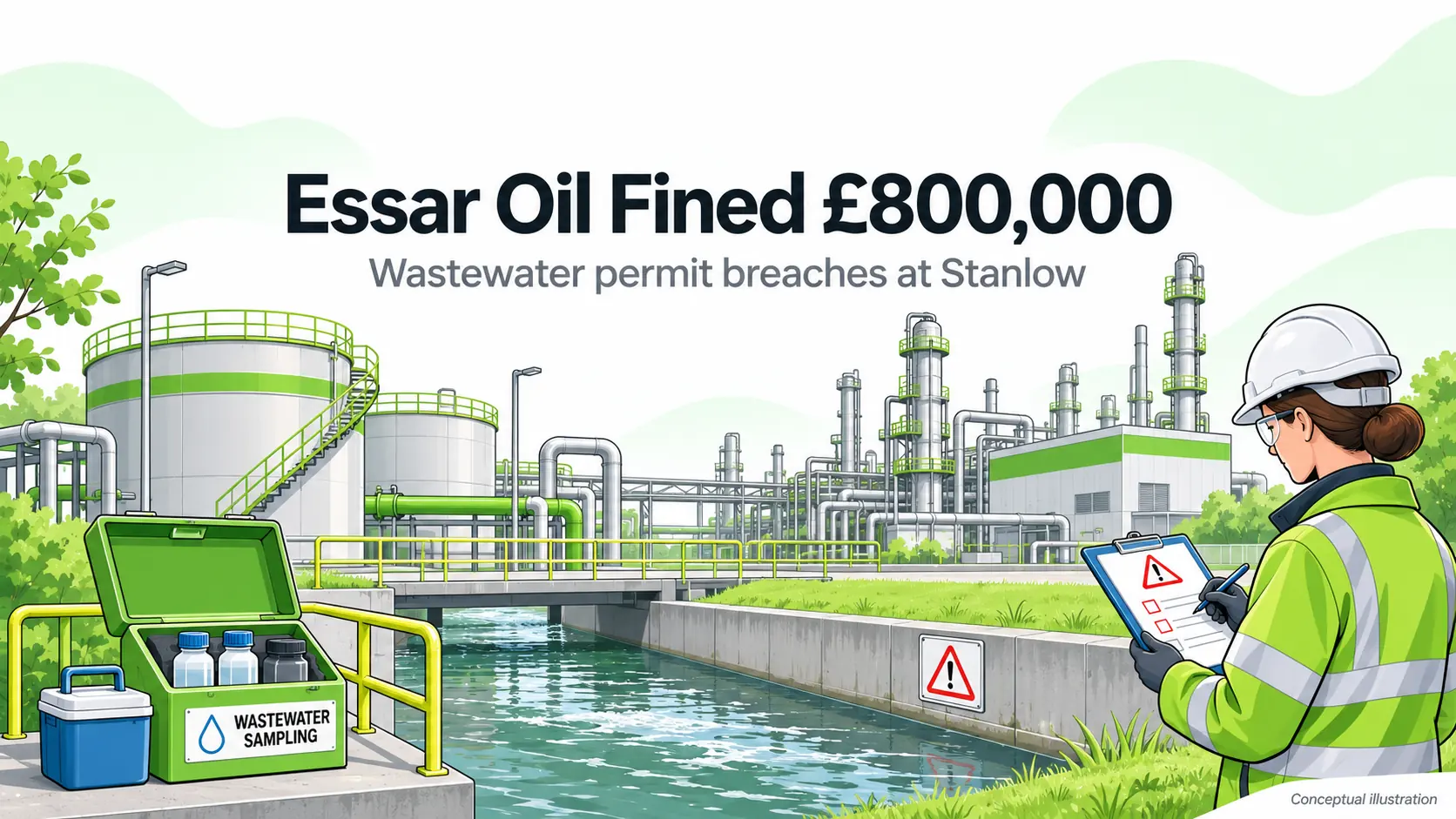
ELLESMERE PORT, CHESHIRE, UNITED KINGDOM — Essar Oil (UK) Limited was fined £800,000 at Warrington Magistrates’ Court on 19 November 2026 after admitting environmental offences at its Stanlow Manufacturing Complex. The Environment Agency said the refinery exceeded wastewater permit limits at least 489 times between 2018 and 2020.
Fine and Costs Total £873,473
The company received a fine of £80,000 for each of ten offences and was ordered to pay £73,473 in costs. It had pleaded guilty to all twelve charges on 11 March 2026. No further separate penalty was imposed for the two other charges concerning distinct 2019 incidents. The total should therefore not be described as a £873,473 fine.
The permit-limit offences concerned trade effluent containing suspended solids, oil and chemicals including cyanide. The affected discharges entered Thornton Brook, the River Gowy and the Manchester Ship Canal, according to the agency’s account.
Separate Releases Exposed Management Weaknesses
In February 2019, between 15 and 20 tonnes of a chemical used to remove hydrogen gas escaped through drainage into the ship canal. Investigators found an open vent and a departure from a written procedure. A separate March 2019 vehicle impact ruptured an effluent pipe, with about 15 tonnes of partially treated sewage discharged during the repair period. The agency said vehicle risks had not been adequately assessed.
These are historical releases described in the new sentencing announcement. The article does not report a fresh leak on 19 November or assign a present-day condition to the waterways.
HSE Blog Analysis
Repeated permit exceedances call for more than treating each sample as an isolated result. Operators need a process that identifies recurring departures, escalates them to people who can act and checks whether corrective action changes performance. Permit compliance depends on the operating system behind the monitoring record.
The separate incidents also connect environmental protection to ordinary workplace controls: following procedures, managing vehicles around vulnerable pipework and responding effectively when equipment is damaged. The principles of workplace chemical safety and keeping risk assessments useful remain relevant across the boundary between occupational and environmental management.
A useful assurance review would examine both routine treatment performance and unusual events, including maintenance, drainage changes and emergency repairs. This is general analysis; it does not add a new technical cause or suggest that the court evaluated measures beyond those described in the public announcement.
Sources and Verification
Checked: the Environment Agency’s 19 November sentencing release, State Integrity’s timestamped reproduction, Britain’s News and OpenGovt’s release index. Four services were checked, but the sentencing detail traces to one authoritative agency account. Reproductions are not independent court reporting. The formal outcome is adequately documented by the prosecuting agency; no additional penalty or finding is inferred.
Featured image: original AI-generated conceptual illustration, not an actual event photograph, technical diagram or evidence of site conditions. Original source imagery remains available with the linked publisher; no unverified photograph is reproduced.
Source
Environment Agencygov.uk