MANDURAH / PERTH, WESTERN AUSTRALIA, AUSTRALIA — An electrical contractor has been fined A$15,000 over a battery installation capable of sending hazardous voltage back into the network during an outage, Western Australia’s government announced on 19 November 2026. The regulator highlighted the danger to electrical workers who might otherwise expect the network to be de-energised.
Completion Notice Did Not Match the Testing Coverage
Jijiba Pty Ltd, trading as Universal Solar & Electricals, pleaded guilty at Perth Magistrates Court to breaching the Electricity (Licensing) Regulations 1991. The installation was at a Meadow Springs home in October 2025. Although the location was residential, the enforcement announcement identifies a direct risk to people working on the electricity network.
According to the regulator, the electrician’s test sheet lacked a section for battery-system checks, yet the company submitted a completion notice declaring the installation checked, tested and compliant. A later Western Power inspection identified incorrect wiring that could back-feed the grid and expose workers to an electric shock exceeding 230 volts.
The sentencing hearing was on 23 October 2026. The company was also ordered to pay A$825 in costs. The fresh announcement is the government’s first-published release dated 19 November; it is not a new accident or a claim that someone was injured.
HSE Blog Analysis
The case illustrates how a completion form can give false assurance when it omits part of the equipment actually installed. Adding a battery or another source of stored energy changes the scope of verification. A document designed around a simpler installation may no longer cover the conditions that matter.
For contractors, the practical question is whether their test procedures cover every source of supply and the installation’s abnormal operating conditions, including loss of network power. Verification needs competent people, suitable methods and records that demonstrate what was checked. This article does not provide an installation method or imply that a visual inspection alone can establish safety.
The same principle underlies keeping risk assessments useful: the paperwork should describe and support working controls. It cannot substitute for proving that those controls function. Supervisory review should therefore challenge gaps in test scope before a declaration of compliance is submitted, rather than wait for a network inspection to find them.
Sources and Verification
Checked: the WA government’s 19 November enforcement release, The National Tribune’s 19 November reproduction and Mirage News’s matching release. Three publishing services were checked, but all substantive case facts have one regulator origin. No separate court transcript or independent Western Power account was retrieved. The fine and costs are reported as imposed, while the electrical harm described is a risk, not an injury count.
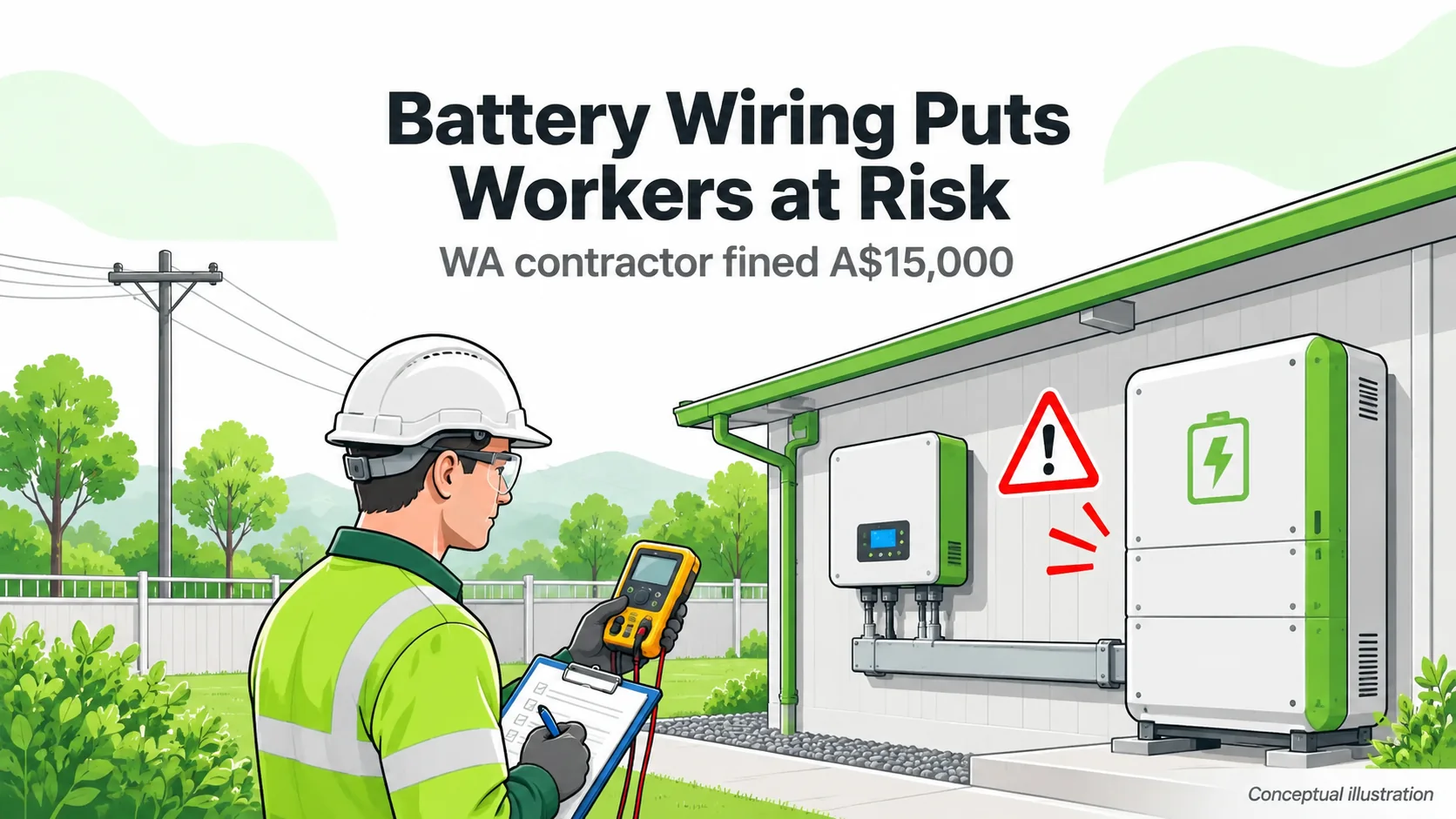
Featured image: original AI-generated conceptual illustration, not an actual event photograph, technical diagram or evidence of site conditions. Original source imagery remains available with the linked publisher; no unverified photograph is reproduced.
Source
WA Director of Energy Safetywa.gov.au