NEW SOUTH WALES, AUSTRALIA — NSW announced on 20 November 2026 that body-worn cameras will become a permanent tool for security staff across its hospitals. The decision follows a trial across 15 hospitals and is intended to help staff de-escalate violent incidents.
Procurement Planned for Early 2027
NSW Health says procurement will begin early next year. Staff participating in the trial can retain and continue using their devices in the meantime. The announcement is a commitment to wider provision; it does not mean every hospital security officer has already received a camera.
The department describes initial trial insights as indicating a useful role in de-escalation. Its release does not provide a quantified reduction in assaults or a published evaluation demonstrating the size of any effect.
Violence Prevention Requires Several Controls
NSW Health lists existing measures including recognising escalating behaviour, sharing risk information, shift safety huddles, security patrols, assistance systems, access restrictions and staff education. Its safety taskforce includes health-system, union and local health district representatives.
Health Services Union secretary Gerard Hayes supports the commitment in the departmental release, while acknowledging that cameras will not prevent every violent act. That position is consistent with treating recording equipment as one part of a broader response, rather than a complete solution.
HSE Blog Analysis
The important implementation question is what changes for a worker facing escalating behaviour. A camera may record an encounter, but the response still depends on staff recognising danger, obtaining assistance and having a safe way to disengage. Deployment plans should connect devices to those practical arrangements.
Organisations also need clear decisions about activation, access to recordings and support after an incident. These are implementation considerations raised by the technology, not additional requirements announced in this release. Consultation should include the people expected to use cameras and those whose work may be recorded.
Monitoring should distinguish device availability, use during relevant incidents and actual outcomes. Changes in incident reporting can affect apparent trends. Reviewing different forms of workplace violence can help organisations define what they are measuring, while involving workers in risk assessments helps identify gaps between a security policy and the conditions on a ward.
Sources and Verification
Checked NSW Health, the NSW Government’s matching ministerial release, City Hub, Australian Financial News and Sydney Dispatch. The two government pages have one source origin; secondary reports largely rely on that announcement. The union’s position was checked within the official release, not through a separate interview. Five independently corroborating sources were not available.
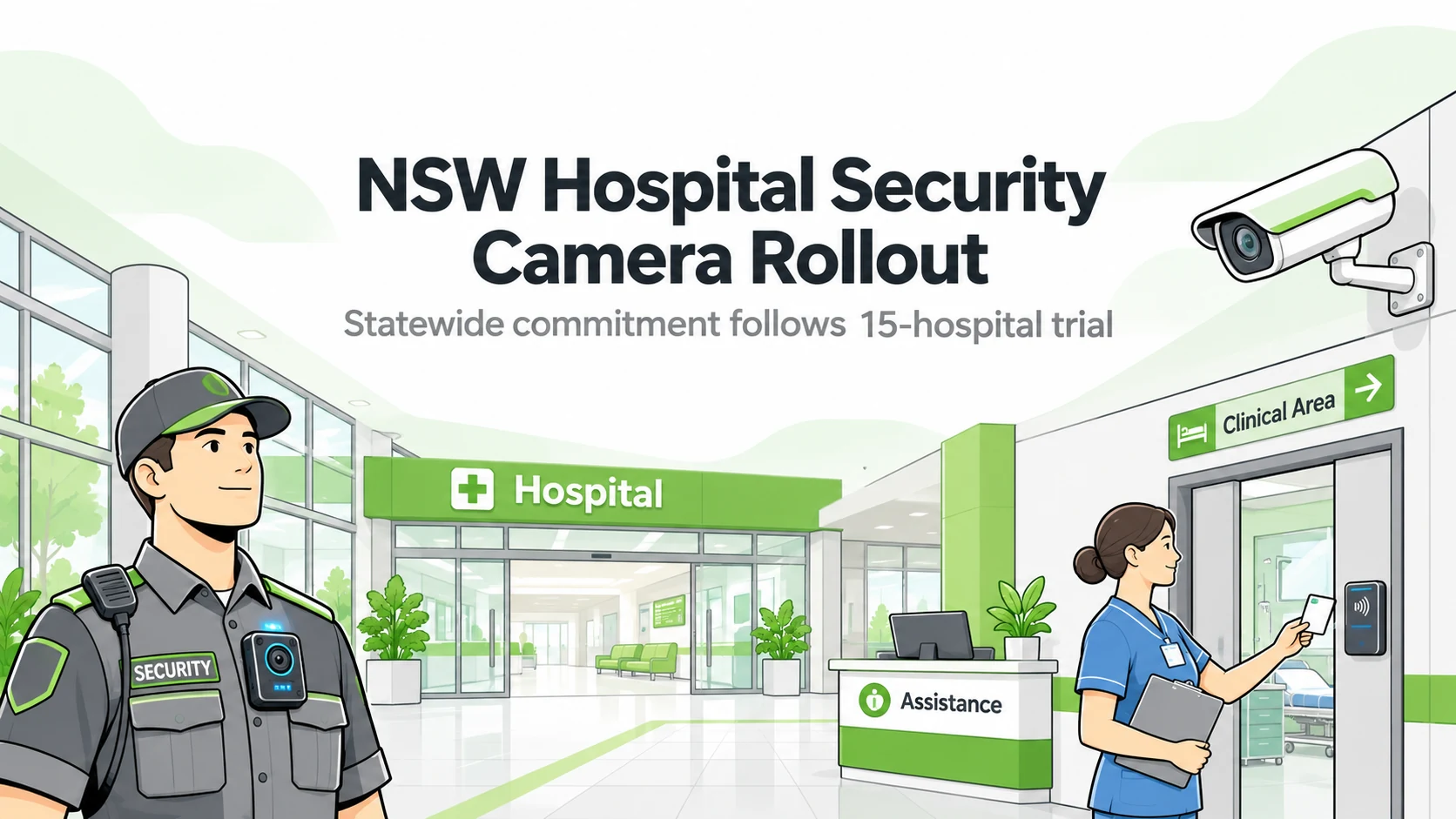
Featured image: original AI-generated conceptual illustration, not an actual event photograph, technical design or evidence of site conditions. Source imagery remains with the linked publishers; no photograph is reproduced without verified reuse permission.
Source
NSW Healthhealth.nsw.gov.au