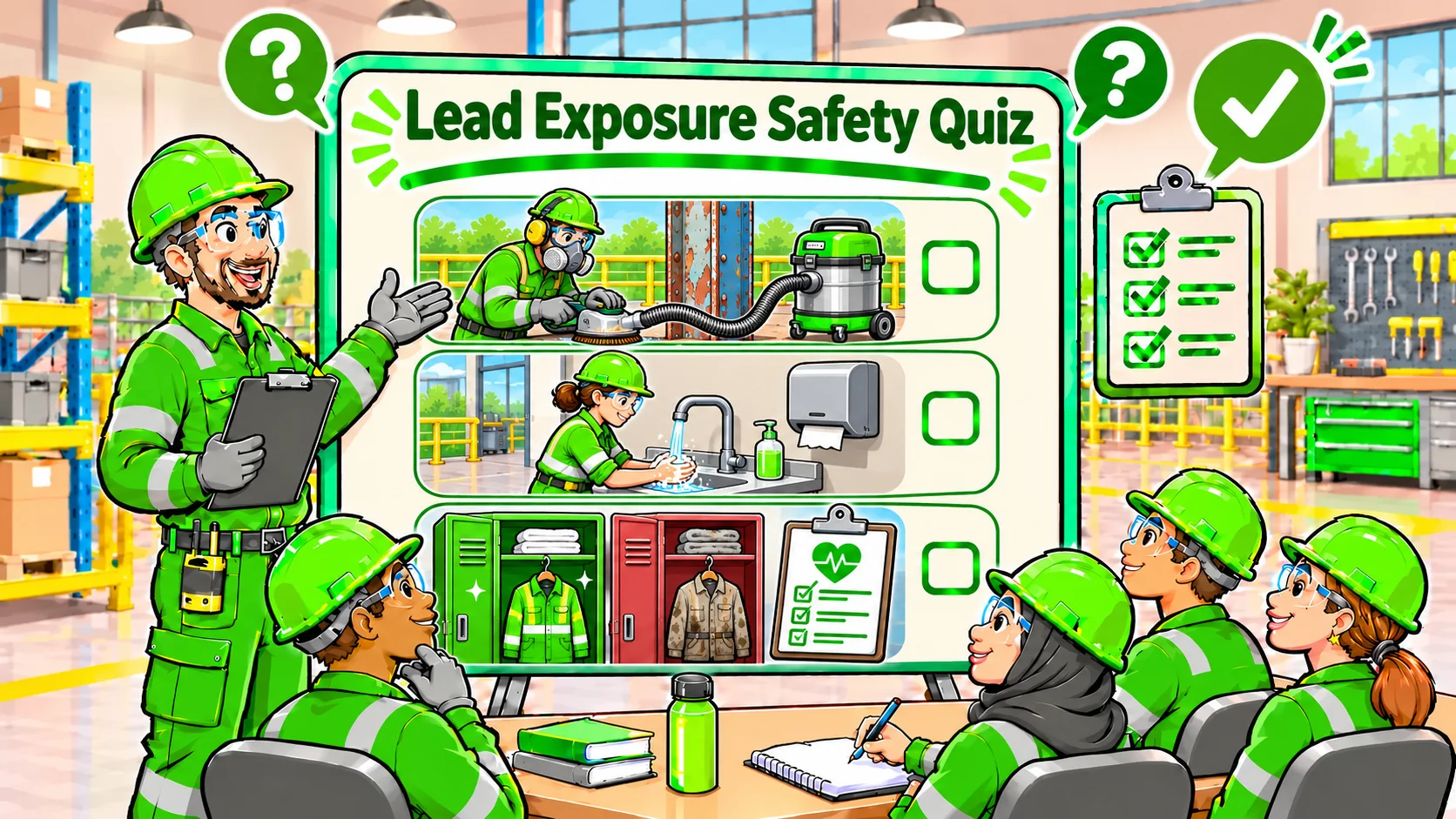
Lead Exposure Safety Quiz: Workplace Controls and Hygiene
25 questions
About 13 min
Updated
0 of 25 answered
Score 0
Question 1 of 25
Which routes commonly allow inorganic lead dust to enter the body at work?
Question 2 of 25
Which job should prompt an assessment for lead exposure?
Question 3 of 25
What should happen before hot cutting metal with a suspect lead-containing coating?
Question 4 of 25
Which measure should be considered before relying on PPE for lead work?
Question 5 of 25
Why might wet methods or on-tool extraction be selected for paint preparation?
Question 6 of 25
A lead-dust extraction system fails during work. What should the worker do?
Question 7 of 25
Where should workers eat and drink during lead work?
Question 8 of 25
Why should hands and face be washed before eating or smoking?
Question 9 of 25
Why does wearing gloves not eliminate the need for hand washing?
Question 10 of 25
What is the appropriate arrangement for contaminated work clothing?
Question 11 of 25
Which practice can transfer workplace lead to a worker's family?
Question 12 of 25
Which housekeeping approach is preferable for lead-contaminated dust?
Question 13 of 25
Why should contaminated waste be collected and managed promptly?
Question 14 of 25
What should determine respiratory protection for lead work?
Question 15 of 25
A worker wears a tight-fitting respirator with hair under the seal. What is the concern?
Question 16 of 25
What does a blood-lead measurement help assess?
Question 17 of 25
Does a normal-looking work area prove lead controls are adequate?
Question 18 of 25
Under Great Britain's lead-at-work rules, who should advise on appropriate medical surveillance?
Question 19 of 25
Why must workers attend arranged lead medical-surveillance appointments?
Question 20 of 25
A worker feels well after repeated lead exposure. What is the sound conclusion?
Question 21 of 25
Which health effects can significant lead exposure cause?
Question 22 of 25
What should a worker do about symptoms or concerns after lead work?
Question 23 of 25
Why should barriers or segregation be considered during lead-paint removal?
Question 24 of 25
A colleague suggests barrier cream instead of suitable gloves. What is correct?
Question 25 of 25
What should happen when the lead-work method or materials change?
About This Quiz
Lead exposure is not limited to the person operating a tool. Dust and fume can be inhaled, and contamination on hands, clothing and surfaces can be swallowed or carried into clean areas. This lead exposure safety quiz checks practical decisions before, during and after lead work.
What this quiz covers
Practise lead exposure prevention with 25 questions on source controls, personal hygiene, protective equipment, contamination and medical surveillance.
How to use the quiz
Answer 25 multiple-choice questions with one correct answer each. The practice pass mark is 70%, requiring at least 18 correct answers. There is no time limit. Answer options are shuffled, explanations are available and retakes are allowed. Review the explanations and official guidance for topics you miss.
Scope and limits
Independent awareness practice, not an official examination, medical assessment or authorisation to undertake lead work. General prevention advice follows HSE guidance. References to appointed doctors and lead-at-work medical surveillance concern Great Britain's Control of Lead at Work framework; local requirements elsewhere can differ. No single blood-lead value or air limit is presented as a universal safe threshold. A competent task assessment and relevant medical advice remain necessary.
Sources and further reading
Guidance checked on 27 November 2026. Use current applicable requirements and the arrangements for the actual task and workplace.
Test combustible-dust safety with 25 questions about the explosion pentagon, secondary explosions, hidden deposits, housekeeping and protective systems.