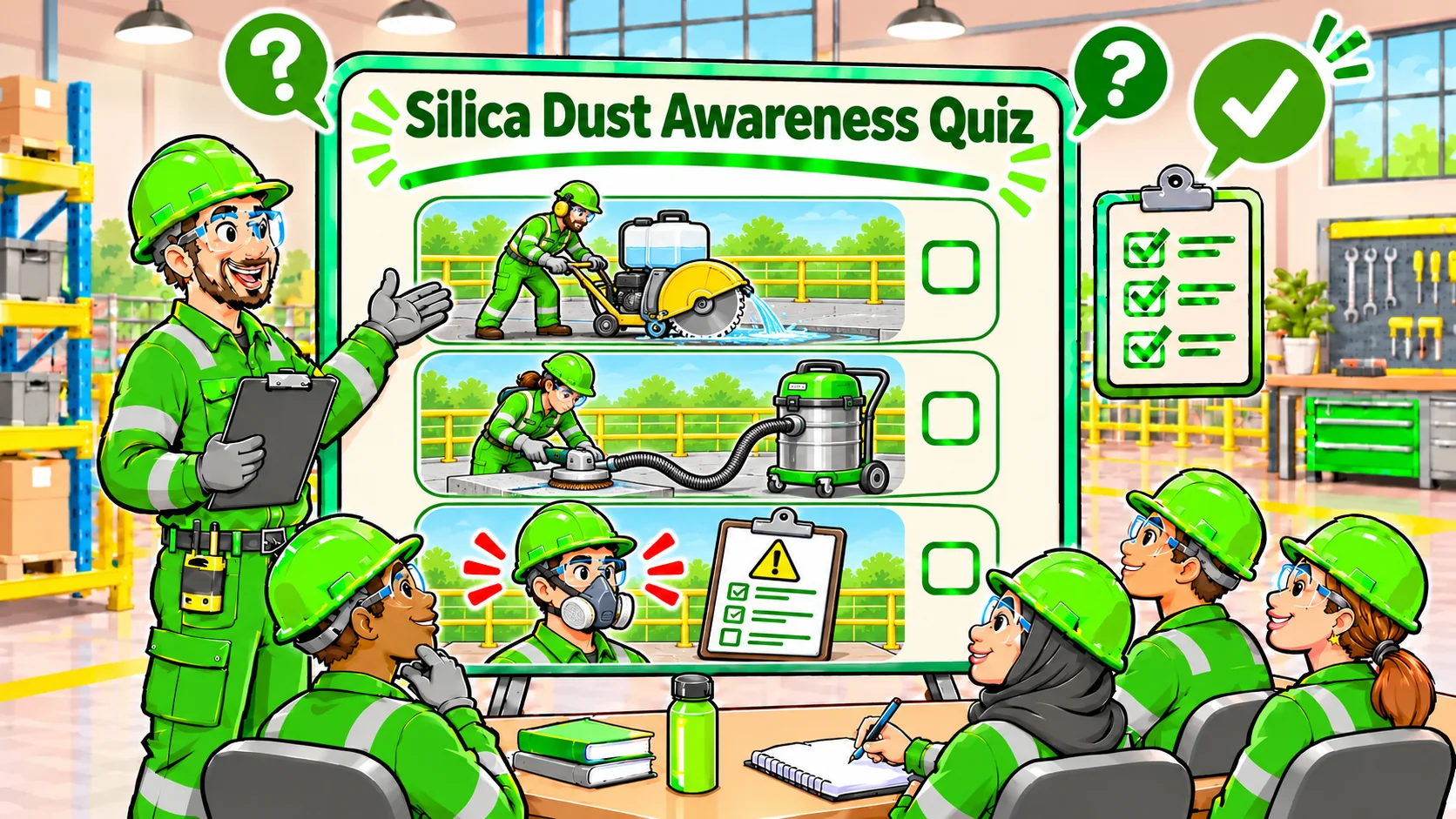
Silica Dust Awareness Quiz: Exposure Risks and Dust Controls
25 questions
About 13 min
Updated
0 of 25 answered
Score 0
Question 1 of 25
What does respirable crystalline silica describe?
Question 2 of 25
Which material may generate crystalline-silica dust when cut?
Question 3 of 25
Which activity commonly creates a silica inhalation hazard?
Question 4 of 25
Why is absence of a visible dust cloud not proof of safety?
Question 5 of 25
Which disease is specifically caused by inhaling excessive respirable crystalline silica?
Question 6 of 25
Which additional health risk is associated with respirable crystalline silica exposure?
Question 7 of 25
Which approach should be considered first when planning a dusty task?
Question 8 of 25
What is the purpose of integrated water delivery on a suitable concrete saw?
Question 9 of 25
Why must water-suppression equipment be checked before use?
Question 10 of 25
What does on-tool local exhaust ventilation aim to do?
Question 11 of 25
Which extraction arrangement is appropriate?
Question 12 of 25
Extraction fails during silica-generating work. What should happen?
Question 13 of 25
Why should access around a dusty task be managed?
Question 14 of 25
What does US OSHA construction Table 1 specify?
Question 15 of 25
Under US OSHA construction rules, what is an alternative when a task is not covered by Table 1?
Question 16 of 25
Under US OSHA 1926.1153, what is the silica permissible exposure limit?
Question 17 of 25
Under US OSHA 1926.1153, what is the action level?
Question 18 of 25
What should determine whether a respirator is needed for a silica task?
Question 19 of 25
What is required for effective use of a tight-fitting respirator?
Question 20 of 25
Which housekeeping method generally helps reduce silica exposure?
Question 21 of 25
Under US OSHA construction rules, when may compressed air be used to clean silica dust from clothing or surfaces?
Question 22 of 25
What should a US OSHA construction silica exposure-control plan describe?
Question 23 of 25
What is the role of the competent person under US OSHA's construction silica standard?
Question 24 of 25
When does US OSHA's construction silica standard require medical surveillance to be offered?
Question 25 of 25
A worker develops persistent breathing symptoms after dusty work. What is appropriate?
About This Quiz
Cutting, grinding and drilling silica-containing materials can release particles that reach deep into the lungs. This silica dust awareness quiz checks how to recognise exposure risks, control dust at source and protect both tool users and nearby workers. It also covers the role and limits of respiratory protection and health surveillance.
What this quiz covers
Answer 25 silica dust questions covering respirable particles, silicosis, wet cutting, on-tool extraction, housekeeping and US OSHA construction requirements.
How to use the quiz
Answer 25 multiple-choice questions with one correct answer each. The practice pass mark is 70%, requiring at least 18 correct answers. There is no time limit. Answer options are shuffled, explanations are available and retakes are allowed. Use the explanations to identify topics for further study.
Scope and limits
Independent awareness practice, not an official OSHA examination or proof of competence for a silica-generating task. Health information follows NIOSH guidance. Table 1, exposure limits, compressed-air restrictions, competent-person duties and the medical-surveillance trigger are explicitly US OSHA construction requirements under 29 CFR 1926.1153. They are not universal limits or the rules for every industry. Consult applicable local requirements, the actual material information and the task-specific exposure-control plan.
Sources and further reading
Guidance checked on 26 November 2026. Apply current requirements and the instructions for the actual equipment and task.
Check respirator fit-testing knowledge with 25 questions on qualitative and quantitative methods, seal checks, facial hair, medical evaluation and retesting.
Practise welding-fume safety with 25 questions covering health risks, source capture, respiratory protection, maintenance and protection of nearby workers.
Heat exposure depends on weather, radiant heat, workload, clothing, and recovery opportunities. This quiz examines preventive planning and recognition of a person who may need urgent help.