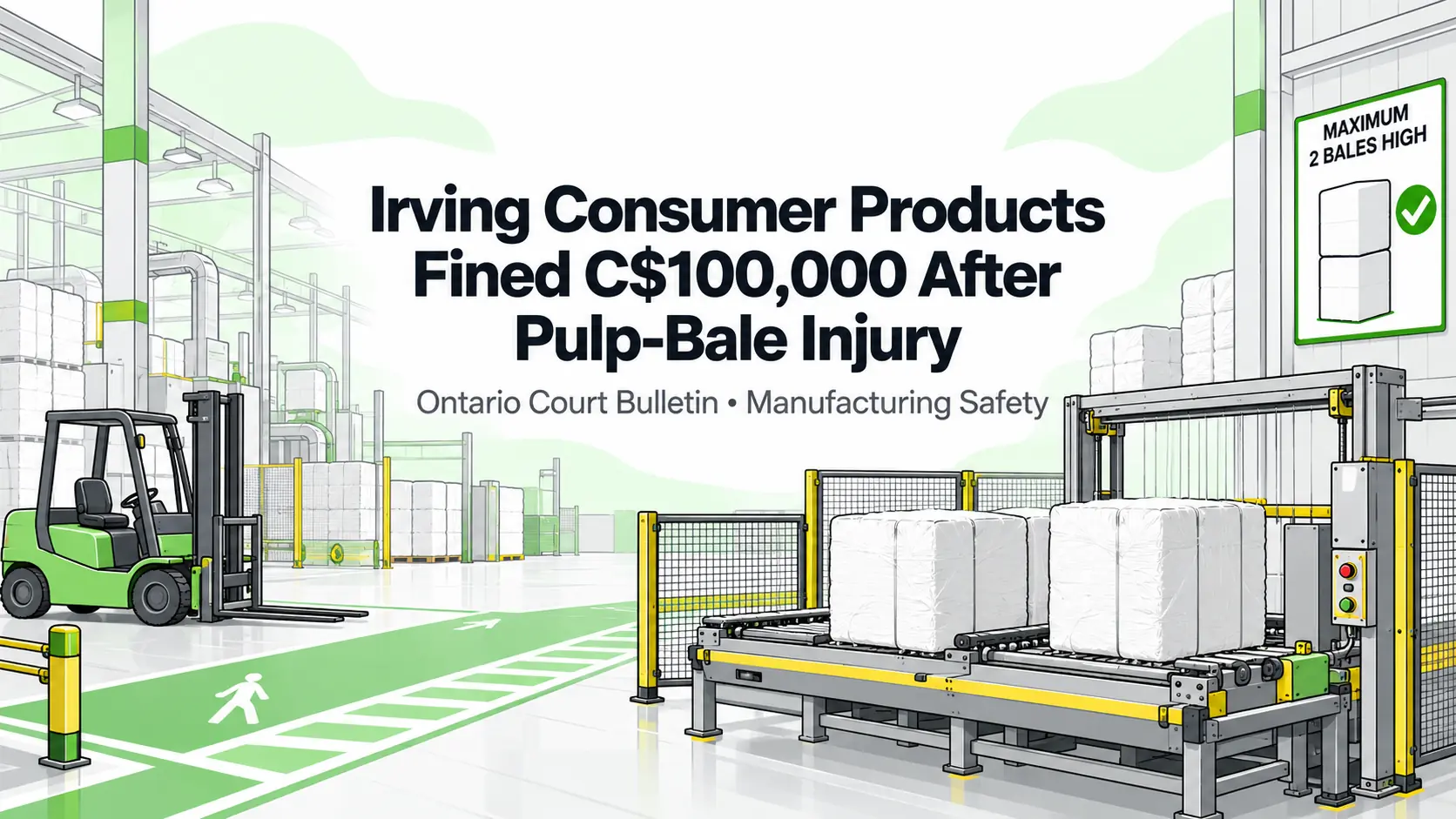
TORONTO, ONTARIO, CANADA — Irving Consumer Products Ltd. has been fined C$100,000 after a temporary-agency worker was critically injured when pulp bales tipped from a wire-cutting table in Toronto.
Ontario’s Ministry of Labour, Immigration, Training and Skills Development published the court bulletin at 3:15 p.m. Eastern time on 27 October 2026—00:15 on 28 October in Pakistan. The conviction itself was entered on 11 September 2026 following a guilty plea.
Four bales were placed where the procedure allowed two
The ministry says the worker was operating a wire-cutting machine at 1551 Weston Road when a lift-truck operator delivered a stack of four pulp bales to the table. The upper two bales tipped and critically injured the worker.
Investigators found that employees hired after 2019 had not been trained on a procedure limiting the table to two bales. Workers had therefore routinely placed as many as four bales on the stand. The company was convicted of failing to ensure that the bales were positioned so they would not tip, as required by section 45(b) of Ontario Regulation 851 under the Occupational Health and Safety Act.
Penalty and corrective action
The Provincial Offences Court imposed a C$100,000 fine and the mandatory 25 per cent victim fine surcharge. Ontario’s bulletin says Irving Consumer Products subsequently redesigned the work area and purchased a new wire chopper.
Those improvements are significant because they address both the immediate handling arrangement and the underlying process. A posted limit is useful only when the equipment, workflow, supervision and training reinforce it.
HSE Blog analysis
This case illustrates how a known safe-work limit can disappear between procedure and practice when onboarding and refresher training are incomplete. Temporary workers must receive site- and task-specific instruction equivalent to that provided to directly employed workers, including load limits, unstable-load hazards and stop-work expectations.
- Define the maximum number, mass and orientation of bales permitted on each table.
- Use physical restraints or equipment design to prevent unstable stacking.
- Verify training competence before assigning a worker to the cutting station.
- Include agency workers in change communication and refresher programs.
- Observe real work practices and correct routine deviations before they become normalized.
HSE Blog’s article on the importance of machine guarding provides context on separating people from moving machinery. The guide to effective safety supervision is also relevant where training and day-to-day practice diverge.
Sources and image note
The facts were checked against the Ontario court bulletin and one separate report that summarized the bulletin. A third service republished the government material rather than providing independent reporting. The preferred five-to-six-source threshold was therefore not met, but the penalty, offence, dates and corrective actions are stated in the authoritative government record.
No actual incident photograph with verified reuse permission or an authorized publisher embed was found. The featured image is a newly generated editorial illustration of safe bale handling, not a depiction of the injury.
Source
Ontario Ministry of Labour, Immigration, Training and Skills Developmentnews.ontario.ca