TE KŌWHAI, WAIKATO, NEW ZEALAND — Waikato Regional Council has announced a NZ$97,500 fine against dairy farmer Wayne Maurice Clarke for unlawful effluent discharge at Te Kōwhai, near Hamilton. Its announcement on 28 October 2026 concerns a sentencing decision released on 15 October, rather than a new discharge.
Clarke pleaded guilty to discharging a contaminant onto land in circumstances where it could enter water, contrary to section 15(1)(b) of New Zealand’s Resource Management Act 1991. The offending occurred on 2 September 2025.
Storage and oversight failed during wet conditions
The council says officers found effluent ponding after irrigation onto saturated ground at the 170-cow operation. They identified insufficient storage and inadequate management of irrigation. The council’s record included an abatement notice, six infringement notices and five formal warnings between 2015 and 2024.
The sentencing decision explains the mechanism: the travelling irrigator reached the end of its run and stopped travelling, but continued applying effluent whenever the sump pump restarted. No failsafe stopped irrigation at the end of the run. Officers recorded a ponded area approximately 20 metres across and up to 12 centimetres deep.
The court also recorded a gap in supervision while the farm manager was off duty. No alternative arrangement had been established to monitor the effluent system during that absence. Judge Melinda Dickey assessed Clarke’s conduct as highly careless.
What the outcome means for farm operators
The prosecution concerns environmental compliance in a working dairy business. It demonstrates how storage capacity, automatic controls and staffing arrangements interact: a system that requires irrigation when soil conditions are unsuitable can create a foreseeable pollution risk.
The judgment identifies a conviction and fine. The council’s announcement and available reporting do not establish whether an appeal has been filed. They also do not provide a verified account of subsequent system upgrades, so no completed remediation is claimed here.
HSE Blog analysis: plan for the days when irrigation must stop
Effluent management needs a defined operating envelope. Storage should give an operator the ability to defer irrigation during unsuitable conditions, while controls should detect a stationary irrigator or other failure before continued pumping produces ponding.
- Assign responsibility for checking soil conditions and authorizing irrigation.
- Provide competent cover whenever the usual operator is absent.
- Check that shutdown arrangements stop discharge when equipment stops moving.
- Record inspections and verify that corrective actions from earlier warnings are completed.
These are operational management considerations, not a claim that one equipment specification suits every farm. The applicable regional rules, consent conditions and site assessment remain decisive. HSE Blog’s guide to environmental management systems provides broader context on assigning responsibilities, monitoring compliance and closing corrective actions.
Sources and documentary images
The council announcement confirms the fine, inspection findings and enforcement history; the linked court decision confirms the plea, legal provision and irrigation mechanism. 1News reporting corroborates the penalty and council account. Five to six independent reports were not available. Scoop reproduced the council release, and DairyNews identified Scoop as its source; those pages were not counted as separate independent confirmations.
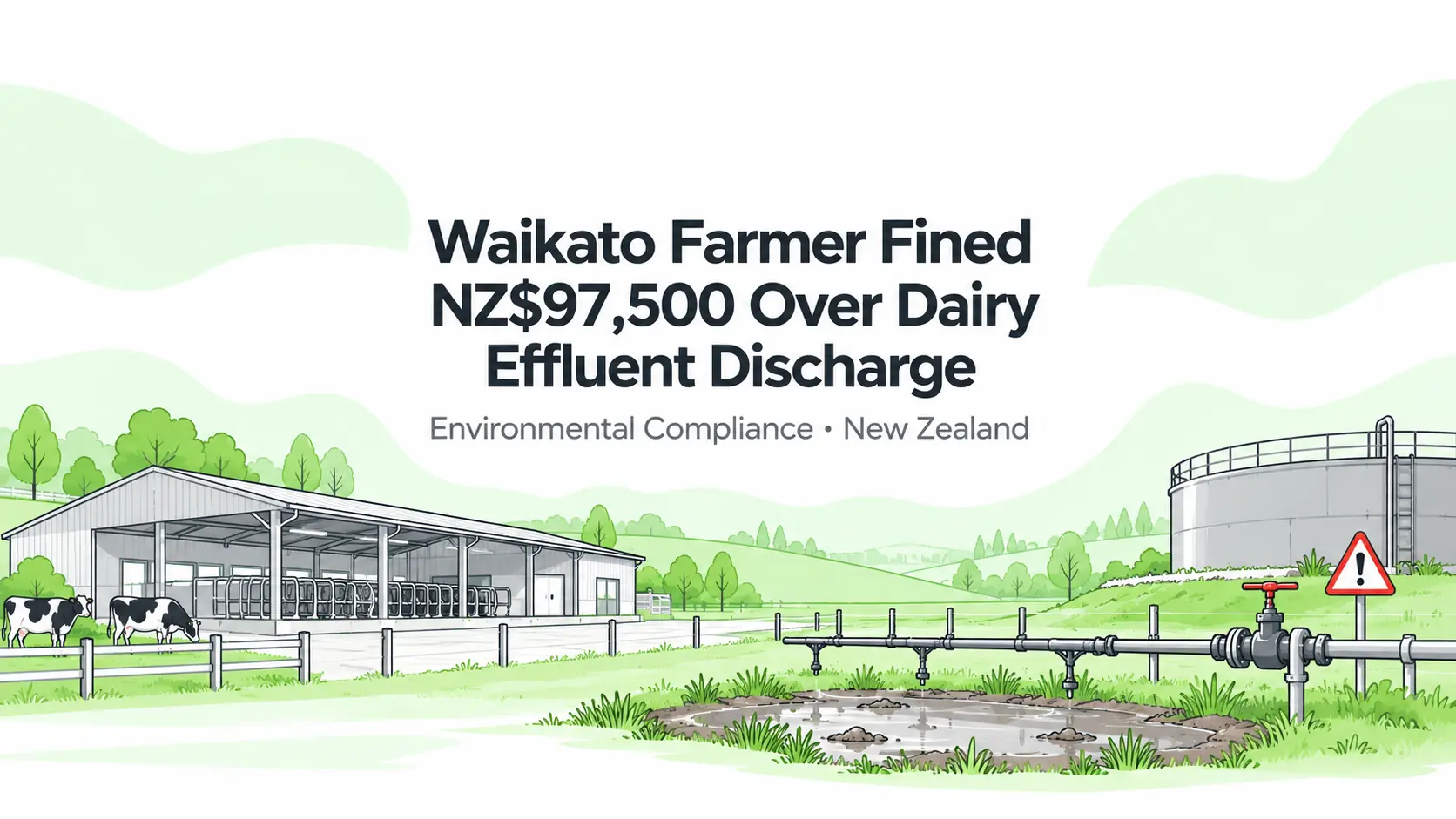
The council and 1News display an authentic image of an officer sampling ponded effluent. No explicit permission covering HSE Blog’s reuse was verified, so readers can view that photograph in the linked original reports. The featured artwork is a dedicated illustration of dairy-effluent management, not a photograph or reconstruction of Clarke’s farm.
Source
Waikato Regional Councilwaikatoregion.govt.nz