BANKSMEADOW, NEW SOUTH WALES, AUSTRALIA — SafeWork NSW has announced that Toll Transport Pty Ltd was convicted and fined A$807,500 over a conveyor incident that left a worker seriously injured at the company’s former Banksmeadow facility in Sydney.
The regulator’s 28 October 2026 release says the prosecution arose from an incident on 20 December 2022. A packline operator was trying to free a jammed pallet with a crowbar when the conveyor moved and the loaded pallet pinned his leg against part of the machinery.
What the court found
Toll pleaded guilty to a Category 2 offence under sections 19(1) and 32 of the New South Wales Work Health and Safety Act 2011. The Industrial Court imposed the A$807,500 fine on 26 October 2026. SafeWork NSW states that Toll retains a right of appeal, so the article reports the sentence as imposed rather than implying that all appeal avenues are exhausted.
Separate reporting on the judgment says the pallet weighed about 1.31 tonnes and that the worker remained trapped while colleagues removed 25-kilogram bags. The court was told that pallet jams had become frequent and that workers lacked a written safe procedure for clearing them.
Energy isolation was the central control issue
The case is directly relevant to machinery-safety programs because clearing a jam is an intervention into a hazardous system, not routine production. A conveyor can retain or regain mechanical energy even when a local control appears inactive. The control sequence should therefore define shutdown, isolation, lockout, verification of zero energy, and controlled restart.
HSE Blog’s guide to common lockout/tagout mistakes explains why stopping equipment at its operating control is not the same as isolating hazardous energy. Its overview of machine guarding also describes the role of physical barriers around moving parts and access points.
HSE Blog analysis
The practical lesson is not limited to conveyors. Repeated jams, improvised tools and worker-developed workarounds are leading indicators that the formal system of work no longer matches actual operations. Employers should treat an increase in jam frequency as a trigger for engineering review, not merely as a productivity issue.
- Design out recurring jams where reasonably practicable.
- Provide a documented, task-specific isolation method for fault clearing.
- Locate lockable isolators where workers can control their own exposure.
- Train and assess every person expected to intervene in the machinery.
- Audit what workers actually do during abnormal conditions and restart.
The court decision also demonstrates that administrative controls cannot be absent where foreseeable interventions bring workers close to moving plant. Toll’s post-incident engineering work does not alter the duty that applied at the time of the incident.
Sources and image note
The essential facts were checked against the SafeWork NSW announcement, the published court reporting, and two separate specialist reports. One additional page reproduced the regulator’s release and was not counted as independent reporting. The preferred threshold of five to six genuinely independent sources was not available.
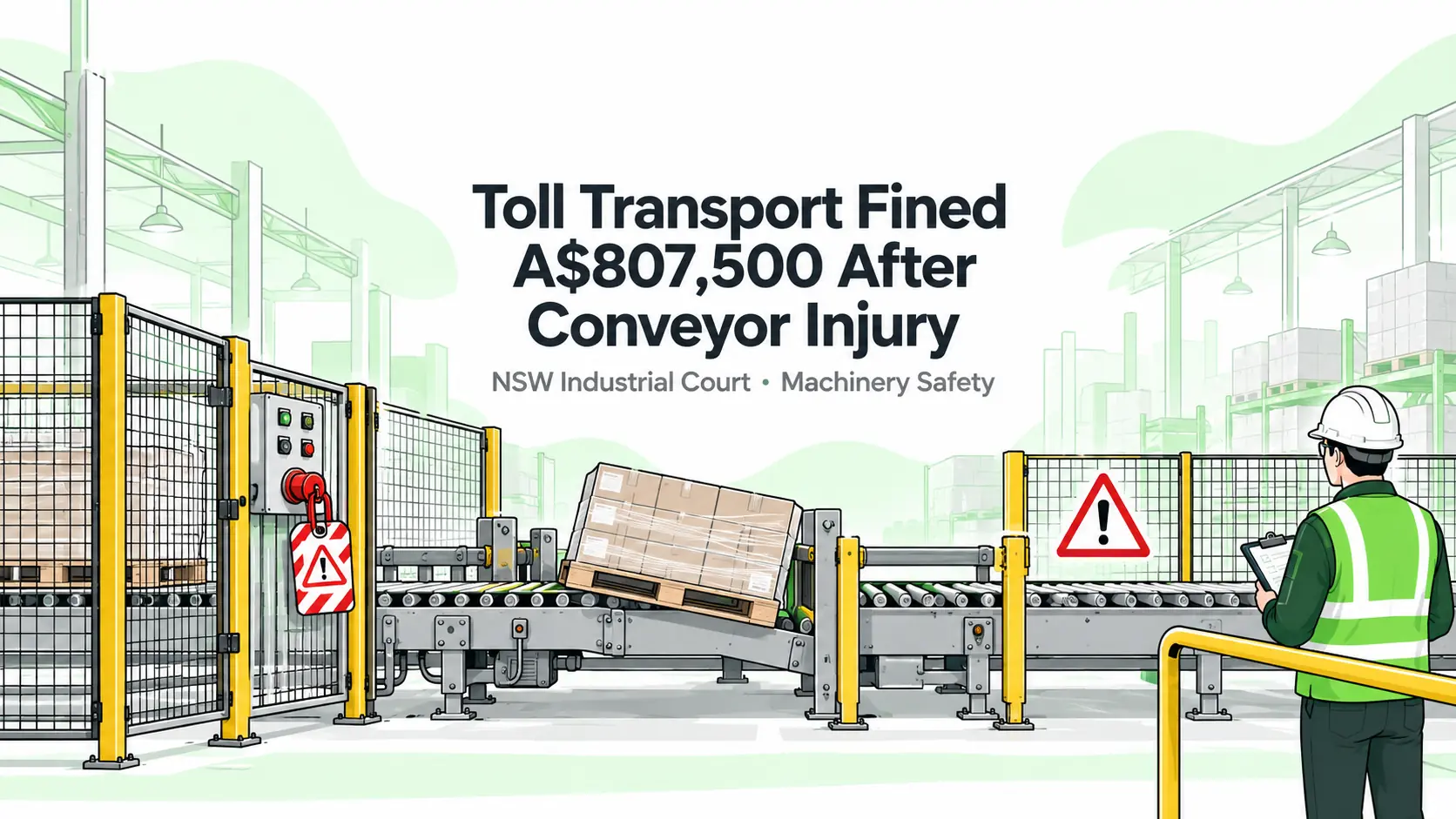
News reports carried illustrative or publisher-owned imagery, but no documentary incident photograph with reuse permission or an authorized embed suitable for HSE Blog was verified. The featured image is a newly created editorial illustration and is not a photograph of the incident.
Source
SafeWork NSWsafework.nsw.gov.au