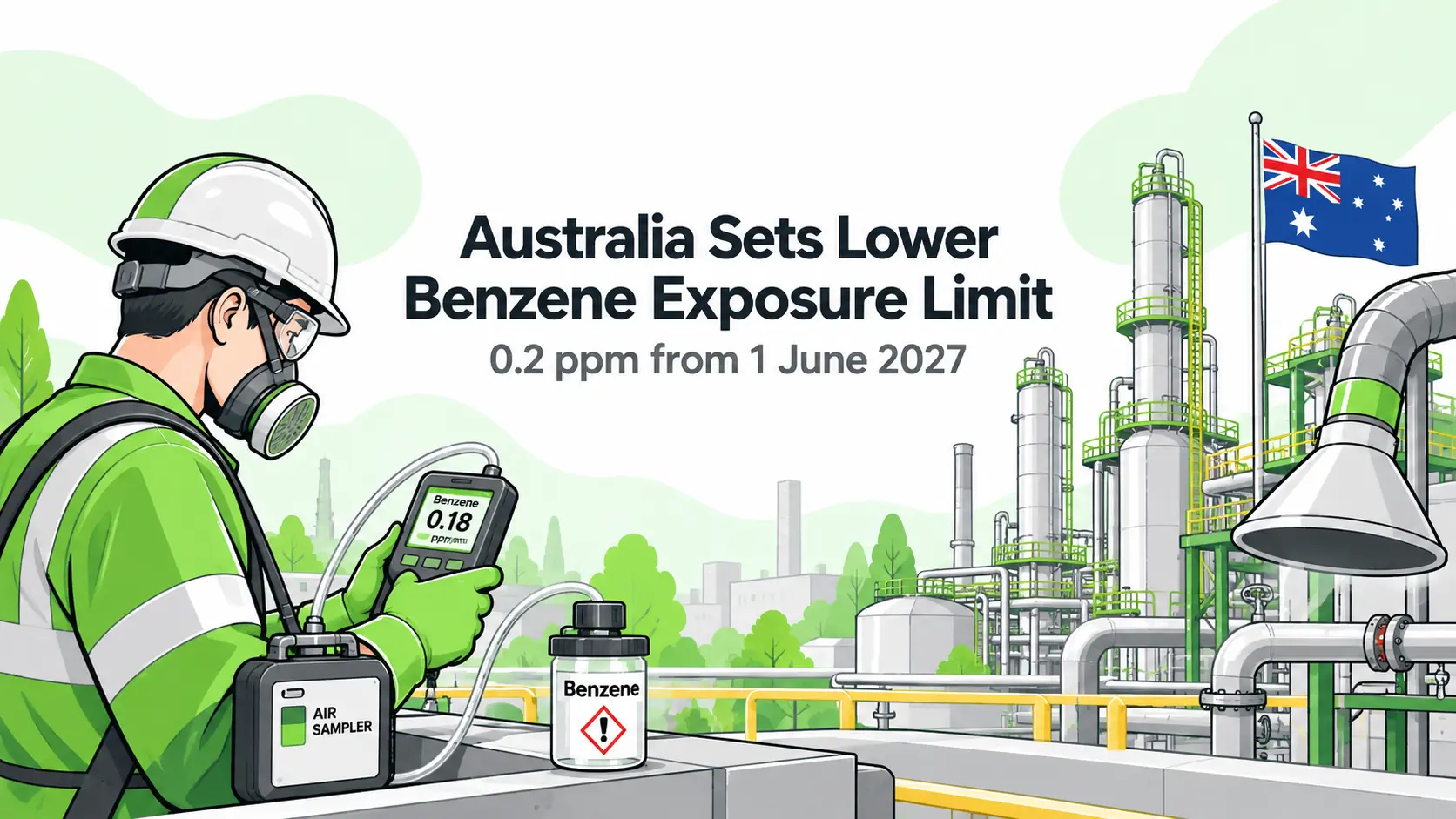
AUSTRALIA — Australia will reduce the workplace exposure limit for benzene to 0.2 parts per million from 1 June 2027, following agreement by work health and safety ministers. The new value is 0.7 mg/m³ as an eight-hour time-weighted average.
Safe Work Australia announced the decision on 29 October 2026. Until the change takes effect, the current limit of 1 ppm (3.2 mg/m³) remains in place.
What the decision changes
The new limit cuts the numerical threshold by 80 per cent. Safe Work Australia said the transition period is intended to give industry time to review exposure monitoring, compliance arrangements and control measures.
The benzene timetable is separate from Australia’s broader transition to workplace exposure limits for other airborne contaminants, which remains scheduled for 1 December 2026. Employers must check how the limit is implemented by their state or territory regulator.
Why benzene is an occupational-health priority
Benzene is a known human carcinogen. Safe Work Australia links workplace exposure with serious long-term effects, including blood cancers such as acute myeloid leukaemia. Its June 2026 regulatory impact assessment estimated that 156,908 Australian workers may be at risk of benzene exposure each year and said exposure around the current 1 ppm limit can cause blood toxicity, genetic damage and cancer.
The national decision follows further technical work after ministers did not reach majority support in June for proposed changes covering nine chemicals. Ministers have now adopted the lower benzene value; work on the other eight chemicals continues through an independent expert panel.
What employers should prepare for
The change is not only a new number for safety data sheets. Businesses that use or generate benzene should review where exposure can occur and whether current evidence is sensitive enough to demonstrate control at one-fifth of the existing limit.
- Revisit chemical inventories, process maps and exposure groups.
- Review personal breathing-zone sampling plans and laboratory detection limits.
- Confirm that enclosed systems, local exhaust ventilation and maintenance controls perform as designed.
- Assess non-routine work, shutdowns, sampling, spills and waste handling.
- Update worker information, training and health-surveillance arrangements where required.
- Check the implementation position of the relevant state or territory WHS regulator.
HSE Blog’s guides to workplace exposure monitoring and occupational exposure limits provide further context on sampling and interpreting time-weighted limits.
HSE Blog analysis
The delayed effective date provides a preparation window, but workplaces should not treat 31 May 2027 as the start of the project. Lowering the limit from 1 ppm to 0.2 ppm can affect sampling methods, detection capability, the adequacy of ventilation and the definition of similar exposure groups. Early baseline monitoring will help employers identify where engineering changes or work-practice controls may be needed.
This report relies on the primary Safe Work Australia announcement and its supporting regulatory impact assessment. One same-day republication was identified, but it reproduces the official release and is not counted as independent reporting. No independently licensed event photograph applies to this regulatory development; no documentary image has been reproduced.
Source
Safe Work Australiasafeworkaustralia.gov.au