
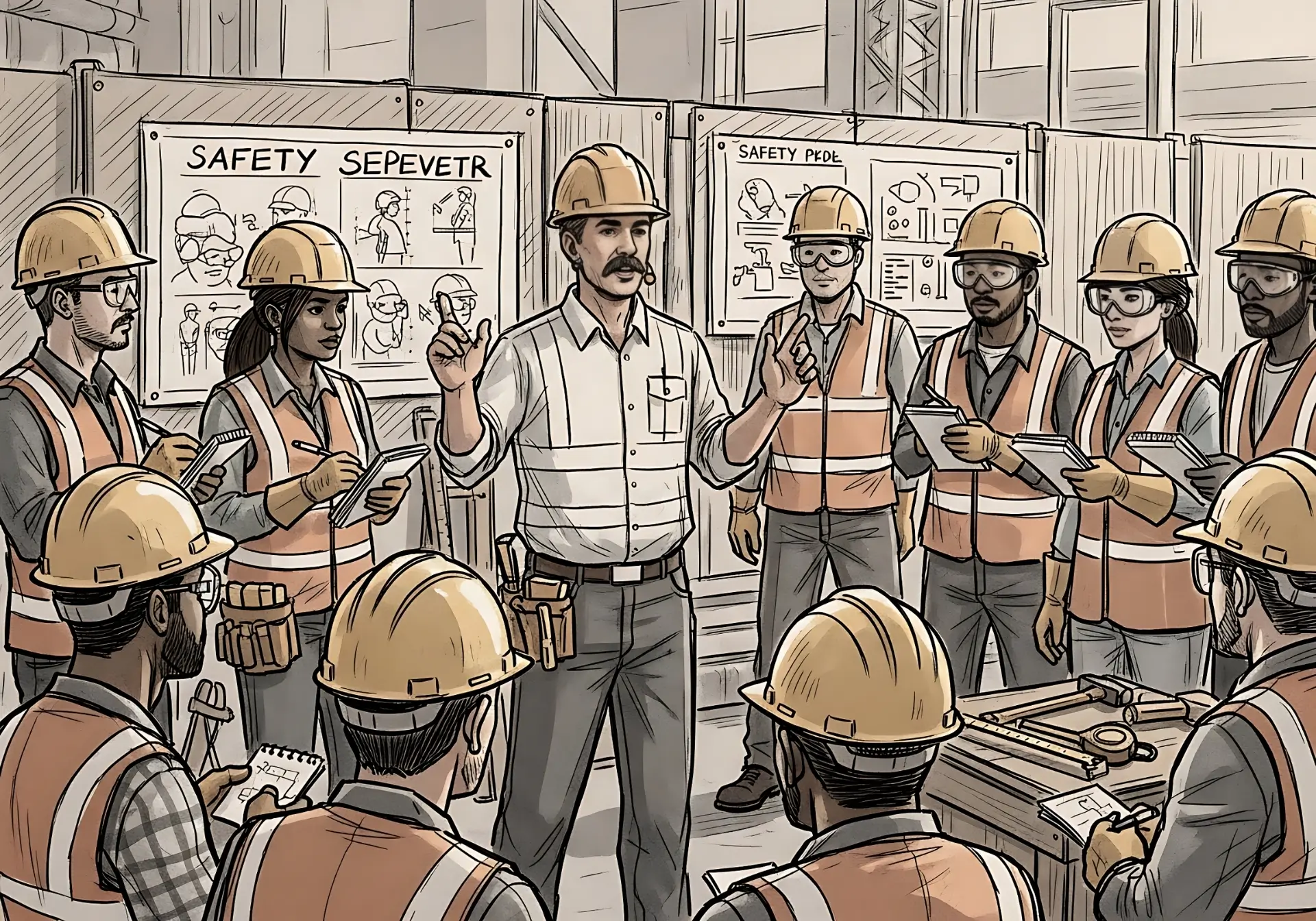
A toolbox talk is a brief, focused safety meeting conducted at the start of a shift or before a task, designed to engage workers in safety discussion, raise awareness of risks, reinforce safe behaviours, and build safety culture.
When the subject is Personal Protective Equipment (PPE), the toolbox talk becomes a critical moment to emphasise how PPE fits into the broader safety system: what it protects against, how it should be selected and used, and why it cannot replace other controls.
Why a PPE-Focused Toolbox Talk Matters
Here are some of the core reasons to devote time to this topic:
- Hazard mitigation: PPE is often the final barrier between a worker and a significant hazard – whether flying debris, chemical exposure, ear-noise, or head injury.
- Legal/compliance obligations: Regulatory bodies such as the Occupational Safety and Health Administration (OSHA) require employers to provide appropriate PPE, to train workers in its use, and to maintain it properly.
- Culture of safety: A consistent talk on PPE reinforces that safety is a shared responsibility – not just “tools and machines” but how each person protects themselves and coworkers.
- Prevention of complacency: Many injuries stem from neglecting or misusing PPE. Reminding teams about proper fit, maintenance, and usage keeps awareness high.
Structuring a Comprehensive PPE Toolbox Talk
Below is a suggested structure for a detailed toolbox talk on PPE, with sections you can adapt to your site, team, and hazards.
1. Introduction & Purpose
- Welcome the team, state the date, location, and task ahead.
- Explain that today’s focus is on PPE — what it is, why we use it, and how to make it effective.
- Point out that PPE isn’t the first defence but a critical last line when other hazard controls can’t eliminate all risk.
2. Define PPE
- Definition: PPE is equipment or clothing worn by a person to minimise exposure to health-safety risks.
- Examples: hard hats, safety glasses/goggles, ear protection, respirators, protective clothing, gloves, boots.
- Emphasise that PPE doesn’t remove the hazard — it protects the individual from it.
3. The Hierarchy of Hazard Controls & Where PPE Fits
- Explain the widely-accepted hierarchy: Elimination → Substitution → Engineering Controls → Administrative Controls → PPE (last resort).
- Stress that while PPE is vital, it’s at the bottom of the pyramid and not a substitute for safer design or safer methods.
- Ask: “What hazards on our site could be eliminated or engineered out instead of relying on PPE?” Make this interactive.
4. Identify the Hazards on Our Site/Task
- Engage participants in naming specific hazards related to the day’s work (e.g., falling objects, chemical splash, noise exposure, welding arcs, trip-hazards).
- For each hazard, ask: “What PPE is required for this hazard?”
- Reference your site-specific risk assessment or Job Safety Analysis (JSA).
5. Selection of Appropriate PPE
- Discuss criteria for selecting suitable PPE: nature of hazard, size/fit of user, compatibility with other gear, and standards compliance.
- Make sure the group knows that using the correct PPE matters — mismatched or poor-quality gear reduces protection.
- Highlight that PPE must meet relevant standards (ANSI, NIOSH, etc.).
6. Proper Use, Fit & Limitations
- Demonstrate or show how to properly don (put on) and doff (take off) various PPE items.
- Emphasise fit: hard hat sits level on the head, goggles wrap properly, gloves fit, respirator seal must be proper.
- Explain limitations: PPE only protects the person wearing it; it doesn’t protect everyone else, and it doesn’t eliminate the hazard entirely.
- Illustrate scenario: wearing safety glasses with side shields for grinding because particles can enter from the side.
7. Inspection, Maintenance, and Storage
- Highlight the importance of checking PPE before every use: cracks, worn parts, seals broken, and straps frayed.
- Storage: keep dry, clean, away from direct sunlight or chemicals, in a designated storage area.
- Replacement: If damaged or past useful life, replace. Employers often must provide replacements at no cost.
- Ask: “When did you last inspect your PPE? What did you find?” Encourage sharing.
8. Responsibilities — Employer & Worker
- Employer responsibilities: assess hazards, supply appropriate PPE, provide training, and maintain PPE.
- Worker responsibilities: use PPE as trained, inspect and maintain it, report defects or needs, and wear it whenever required.
- Emphasise that helmets or gloves don’t protect if they’re left behind or worn incorrectly.
9. Common Errors & Real-Life Examples
- Use anecdotes or recent company incidents/near misses where PPE was not used or misused, and what the consequences were. Real stories resonate.
- Discuss common mistakes: using the wrong type of glove, neglecting worn-out safety glasses, and ignoring ear protection because “just now”.
- Ask: “What have you seen on this site where PPE should have been used but wasn’t? What happened?”
10. Interactive Q&A & Commitment
- Invite questions: “What PPE do you feel is uncomfortable and why?” “What would make its use easier?”
- Ask each team member: “What one thing will you commit to today regarding your PPE?”
- End by reminding: “Wearing PPE isn’t optional — it’s protecting your life, your health, your ability to go home safely.”
11. Documentation & Follow-up
- Note the date, time, attendees, and topic in your safety meeting log.
- If any PPE issues were identified (missing items, damaged gear), assign follow-up to fix them.
- Revisit the subject periodically — PPE talks should not be a one-off. They build culture.
Example Hand-out / Talking Points for PPE Toolbox Talk
“To protect you from hazards when other controls can’t fully eliminate the risk.”
This line explains why PPE is necessary. Even after implementing safety measures like engineering controls (e.g., guards, ventilation) and administrative controls (e.g., safe work procedures), some risks remain. PPE acts as the last line of defense against those residual hazards. It reminds workers that PPE is not a substitute for eliminating hazards but a complementary protection when risks cannot be entirely removed.
Types of PPE:
- Head (helmets/hard hats)
- Eye/Face (safety glasses, goggles, face shields)
- Hearing (earplugs, earmuffs)
- Respiratory (dust masks, respirators)
- Hand (gloves)
- Foot (safety boots)
- Body (coveralls, hi-vis, harnesses)
This section lists the main categories of protective gear and gives examples of each type. Each category corresponds to a part of the body that could be injured during work:
- Head protection: Prevents injuries from falling objects or impact.
- Eye/face protection: Shields against dust, splashes, sparks, and debris.
- Hearing protection: Reduces exposure to loud noise that could cause hearing loss.
- Respiratory protection: Filters harmful dust, fumes, or vapors.
- Hand protection: Guards against cuts, burns, or chemical contact.
- Foot protection: Protects from crushing, punctures, or slips.
- Body protection: Covers against heat, chemicals, weather, and visibility hazards.
This concise list helps workers quickly recall which PPE applies to which hazard.
Key rules:
- Use the right gear for the task.
- Fit it correctly — ill-fitting gear may fail.
- Inspect before each use.
- Store and maintain properly.
- If damaged or missing, report and replace.
Our responsibilities: The Employer provides, trains, and maintains. The worker uses, inspects, and reports.
Remember: PPE reduces risk — it does not eliminate it. Safe work starts with hazard control — PPE protects you when control isn’t enough.
Best Practices to Make This Toolbox Talk Effective & Engaging
- Keep it brief but meaningful: Aim for 10-15 minutes — long enough to engage, short enough to maintain attention.
- Use visuals or demonstrations: Show defective PPE vs good PPE; do a don/doff demo.
- Tailor to your audience and site: Reference actual tasks, actual PPE items used on your site.
- Encourage participation: Ask open questions, invite stories, and get the team involved rather than just lecturing.
- Focus on action and ownership: Don’t just share information — ask each person to commit to something (e.g., inspect their boots, tag damaged gloves).
- Follow-up: At the next talk or shift meeting, revisit commitments, check if issues were fixed, and keep the topic alive.
- Lead by example: Supervisors and site leads must wear their PPE properly, visibly inspect gear, and reinforce positive behaviours.
- Link PPE use to real outcomes: Share stories where PPE prevented injury, or where injury occurred because PPE wasn’t used. Real-world connection increases buy-in.
Summary
A toolbox talk on PPE is more than just a checklist of gear: it’s a vital part of workplace safety culture. It links hazard awareness to practical protection, empowers workers to take ownership of their safety equipment, and reminds everyone that protection is only as good as how we use it.
By carefully planning the talk, tailoring it to the tasks at hand, and engaging your team, you transform PPE from a “nice-to-have” into a habit — a habit that ensures each worker goes home safe, every day.